
 English
 French
 Deutsch
 العربية
 Español
 Русский
 にほんご
にほんご Português
 한국어
한국어
31 Aug

Why Metal 3D Printing Quotes Vary So Widely
Request the same metal bracket from five different suppliers and you may receive five quotes that differ by a factor of three or more. This is not necessarily a sign that someone is overcharging—it reflects the fact that metal 3D printing price is built from a stack of variables that each vendor weights differently: powder material, machine occupancy time, support volume, nesting efficiency, post-processing scope, inspection level, and overhead allocation. A buyer who only compares the bottom-line number without understanding these components risks either overpaying for unnecessary services or, worse, selecting a quote that silently skips critical steps like stress relief or porosity inspection. At HUANYA, every metal 3d printing service quote is itemized so you can see exactly what drives the cost.
The first step to reading a quote intelligently is recognizing that SLM and DMLS parts are not priced like machined or injection-molded components. There is no tooling amortization, but machine hourly rates are high because industrial metal printers represent capital investments of $500,000 to $2 million, require argon or nitrogen consumption, and depend on skilled operators. The metal 3d printing cost of a part is therefore dominated by build time and material rather than by its geometric complexity alone—a counterintuitive fact that catches many first-time buyers off guard. The following sections break down every cost layer in sequence so that your next quotation comparison is based on substance, not guesswork.

Material Cost How Metal Powder Drives Pricing
Metal powder is the most visible cost line on a quote, and also the most misunderstood. The powder used in SLM is not ordinary metal dust: it must be gas-atomized into near-perfect spheres between 15 and 53 micrometers, with controlled oxygen content and particle size distribution to ensure uniform layer spreading and full fusion. Aerospace-grade titanium powder, for example, can cost four to eight times more per kilogram than stainless steel powder because titanium is reactive during atomization and requires stricter inert-gas processing. The table below shows typical market price ranges for common SLM powders; note that certified grades with mill test certificates carry a premium of 20-40% over standard grades.
Material | Powder price range (USD/kg) | Typical density (g/cm³) | Certified grade premium |
|---|---|---|---|
316L stainless steel | $30 - $60 | 7.98 | +20-30% |
AlSi10Mg aluminum | $50 - $100 | 2.68 | +20-35% |
Ti6Al4V titanium | $200 - $400 | 4.43 | +25-40% |
Inconel 718 | $150 - $300 | 8.19 | +25-40% |
CoCr cobalt-chrome | $150 - $250 | 8.30 | +20-35% |
What matters for your part price is not the powder price alone, but the effective material consumption: part volume multiplied by density, plus support structures, plus a process-loss factor. Unmelted powder in the build chamber is typically sieved and reused—HUANYA maintains strict powder traceability and blend ratios—but the first fill of a fresh material batch, mandatory for medical and aerospace jobs, carries a minimum-charge that low-volume buyers should anticipate. Hollowing out a bulky part or converting solid regions to lattice structures can cut material consumption by 40-70%, which is why design-for-additive-manufacture (DfAM) review is one of the fastest ways to lower a metal 3d printing price without sacrificing function.
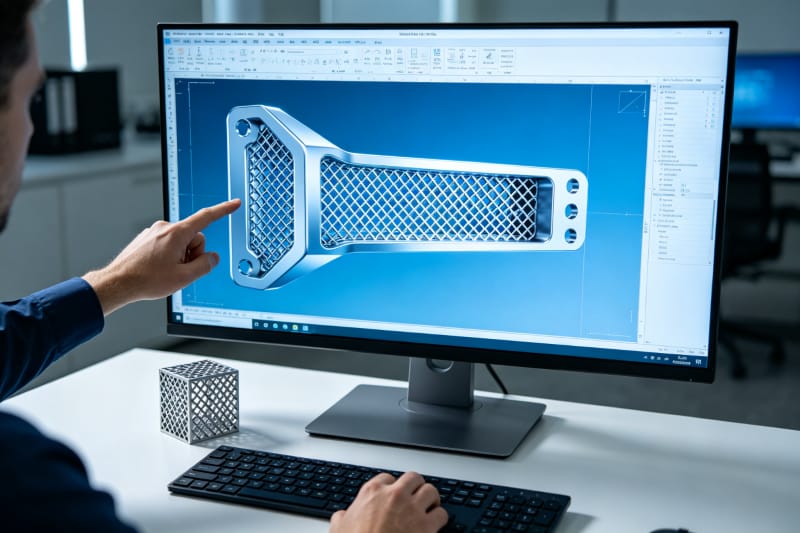
Part Volume and Build Time Machine-Hour Economics
After material, machine time is the second pillar of the quote. An SLM printer builds layer by layer, typically at 20-60 micrometers per layer, and the laser scans each layer's cross-section at scan speeds of 800-2000 mm/s. This means build time is driven primarily by the Z-height of the part (number of layers) and total scan area per layer—not by the part's external bounding box. Two parts with identical outer dimensions can have radically different print times: a solid block may take twice as long as a topology-optimized lightweight version of the same envelope. Industrial SLM machine rates typically run $30-$80 per hour depending on the system, so a 30-hour build carries $900-$2,400 in machine cost before material and labor.
Nesting efficiency is the buyer's most underused lever for reducing per-part machine cost. Because the entire build chamber runs for the same duration whether it holds one part or forty, filling the available plate area with multiple copies—or combining several different parts in one build—spreads the fixed machine time across more units. This is exactly why 3d printing batch quoting rewards customers who plan ahead: a single part occupying 10% of the build plate pays 100% of the build setup cost, while a batch filling 80% of the plate may only cost 2-3 times as much in total. When requesting quotes, always ask how the supplier nests parts and whether your batch can share a build with compatible jobs.
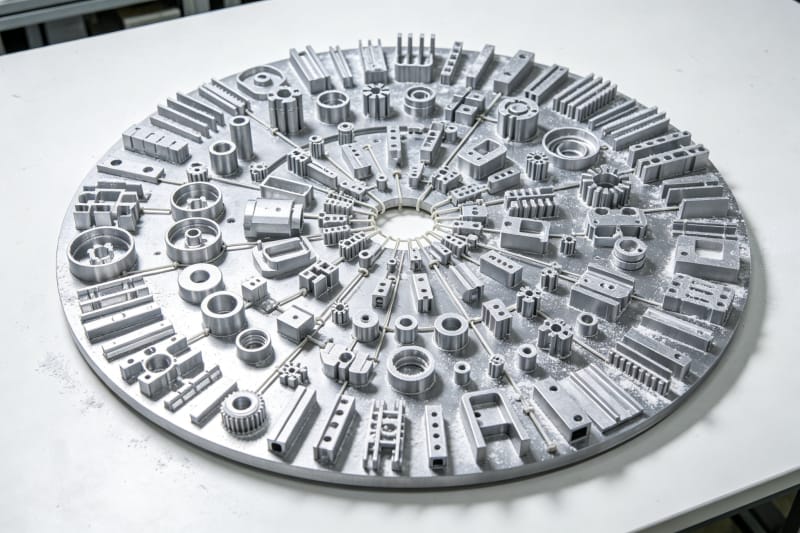
Support Structures and Orientation Hidden Cost Factors
Every overhanging surface below roughly 45 degrees requires printed support structures in metal SLM, and those supports are not free: they consume powder, extend scan time, and—most importantly—must be removed manually after printing. A poorly oriented part with extensive supports can add 30-50% to post-processing labor compared with the same geometry optimized for self-supporting angles. Support removal in metal is also harder than in polymer printing: supports are sintered metal that must be milled, ground, or wire-cut away, and contact marks on cosmetic surfaces may require additional finishing. The orientation decision therefore affects three cost lines simultaneously: build time, support material, and post-processing labor.
Experienced process engineers evaluate multiple build orientations before quoting, trading off surface quality on critical faces against support volume and build height. At HUANYA, orientation optimization is included in every quote rather than billed as a separate engineering service, because fixing a bad orientation after the build starts means scrapping an expensive metal part. Buyers can help by flagging which surfaces are cosmetic, which are functional mating surfaces, and which can tolerate support marks. This information lets the engineer place supports on non-critical faces and minimize removal work—a small communication step that measurably lowers the final metal 3d printing cost.
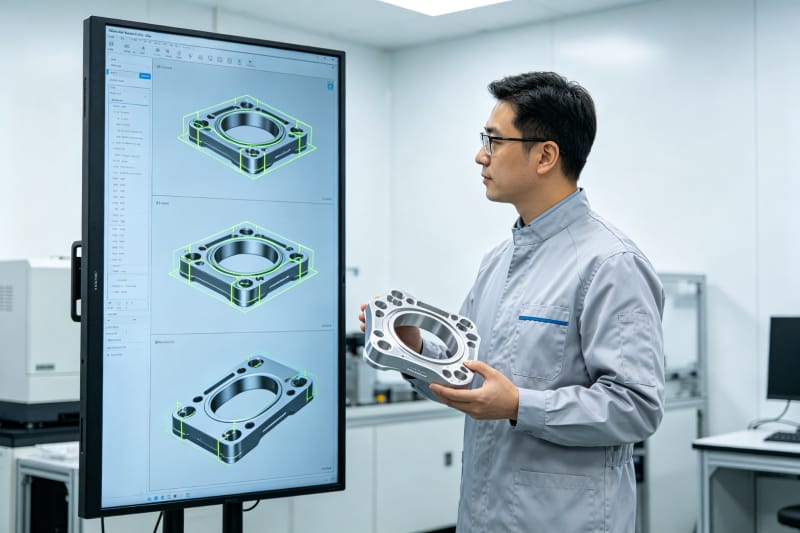
Post-Processing The Variable That Defines Final Price
An as-printed metal part is rarely a finished part. The standard post-processing chain includes powder removal, stress-relief heat treatment (performed while the part is still on the build plate to prevent distortion), support removal, build-plate cut-off via wire EDM or band saw, secondary heat treatment such as solution aging or HIP, bead blasting, CNC finish machining of tight-tolerance features, and optional surface treatments like anodizing, passivation, or polishing. Each step adds cost, and the gap between a quote covering "print only" and one covering "ready-to-install part" can be 40-150% of the print price itself. The table below summarizes typical post-processing operations and their relative cost impact.
Post-processing step | Purpose | Relative cost impact | Typical lead time added |
|---|---|---|---|
Stress-relief annealing | Prevent distortion after plate removal | Low (5-10%) | 0.5-1 day |
Support removal & EDM cut-off | Separate part from build plate | Medium (10-20%) | 0.5-1 day |
Bead / sand blasting | Uniform matte surface, remove powder | Low (3-8%) | 0.5 day |
HIP (hot isostatic pressing) | Close internal porosity, boost fatigue life | High (20-40%) | 2-4 days |
CNC finish machining | Hit tight tolerances & smooth mating faces | Medium-High (15-50%) | 1-3 days |
Polishing / coating / anodizing | Cosmetic or corrosion-resistant finish | Medium (10-30%) | 1-3 days |
The cost-control principle is simple: specify exactly what the part needs, not a generic "best finish." A functional prototype evaluated for form and fit may only require stress relief, EDM cut-off, and blasting—adding precision CNC or mirror polishing wastes budget. Conversely, a production-grade medical or aerospace component that skips HIP or traceable heat treatment to save money may fail certification testing, which is far more expensive. HUANYA's engineers map each post-processing step to the part's actual application, so you never pay for operations you do not need and never miss the ones you do.
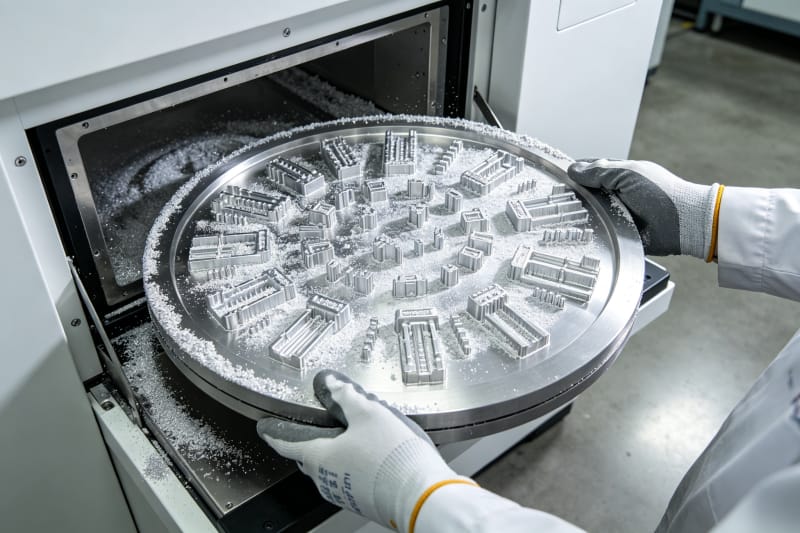
Quality Inspection and Certification Costs
Inspection is where cheap quotes often hide their savings—and their risk. Basic visual inspection and dimensional spot-checks are included in any serious quote, but functional metal parts frequently require more: full dimensional reports from a coordinate measuring machine (CMM), CT scanning to detect internal porosity, mechanical coupon testing, material certificates (EN 10204 3.1), or first-article inspection reports (FAI). CT inspection of a single complex part can cost $100-$400; certified material traceability adds powder lot documentation and archiving; mechanical testing requires printing and destroying witness coupons alongside the build.
The key question to ask any supplier is which inspections are included in the quoted metal 3d printing price and which are billed separately. A quote that looks 20% cheaper may simply exclude dimensional reporting, leaving you to discover tolerance failures at assembly. HUANYA provides a standard inspection package—visual, dimensional sampling, and material certificate—on every order, with optional CMM, CT, and FAI services clearly itemized. For B2B buyers whose parts enter regulated supply chains, this transparency is not a luxury; it is the difference between a usable component and an undocumented liability.
Volume Effect Unit Price Logic From One to Fifty Pieces
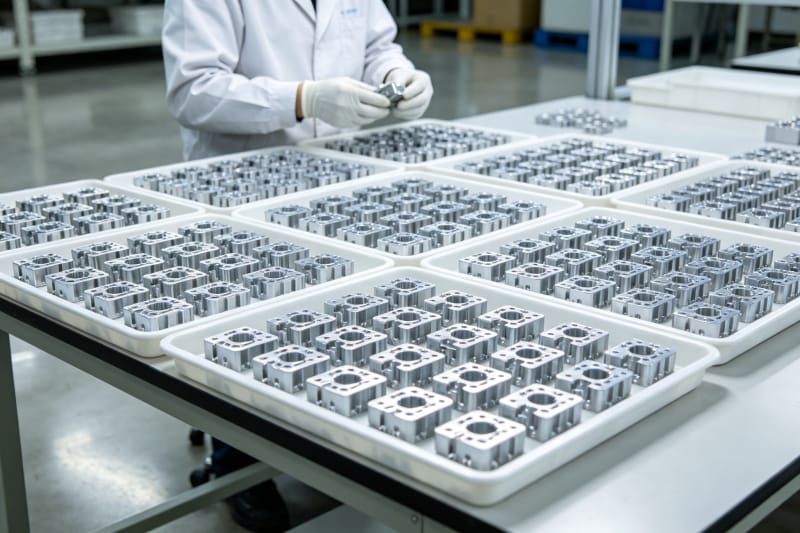
Metal 3D printing has no hard tooling, so its volume economics differ fundamentally from injection molding or casting. From one to ten pieces, unit price drops steeply because build setup, file preparation, and heat-treatment furnace loads are fixed costs shared across the batch; filling the build plate compounds this effect. From ten to fifty pieces, unit price continues declining but more gradually as nesting saturates and additional builds are required. Beyond roughly fifty to one hundred pieces of a small part, alternative processes such as metal casting or CNC from bar stock may become cheaper per unit—a crossover point an honest supplier should flag rather than push more printing volume.
The practical implication for procurement is that ordering one prototype at a time is the most expensive possible buying pattern. Where project timelines allow, consolidating design iterations into a single batch build, or combining several different part numbers in one purchase order, captures the steepest part of the volume discount curve. When HUANYA prepares 3d printing batch quoting, we model several quantity scenarios side by side so buyers can see the exact unit-price breakpoints and choose the quantity that matches both their validation plan and budget—rather than discovering after three separate single-part orders that a single batched build would have cost 40-60% less.

How to Get a Cost-Effective Quote From HUANYA
An accurate, competitive quote starts with a complete information package: a clean STEP or STL file, the target material, required quantities, critical tolerances and cosmetic surfaces, post-processing expectations, and any certification requirements. With these inputs, HUANYA returns an itemized metal 3d printing service quotation within hours—material, build time, post-processing, and inspection listed separately, with DfAM suggestions that can reduce cost before production begins. You will never encounter unstable dimensional accuracy, delivery delays, or inconsistent post-processing quality, because every job follows a standardized process route with in-process checks. Upload your file today and see exactly what your metal parts should cost, with no hidden line items.


Leave a Comment