
 English
 French
 Deutsch
 العربية
 Español
 Русский
 にほんご
にほんご Português
 한국어
한국어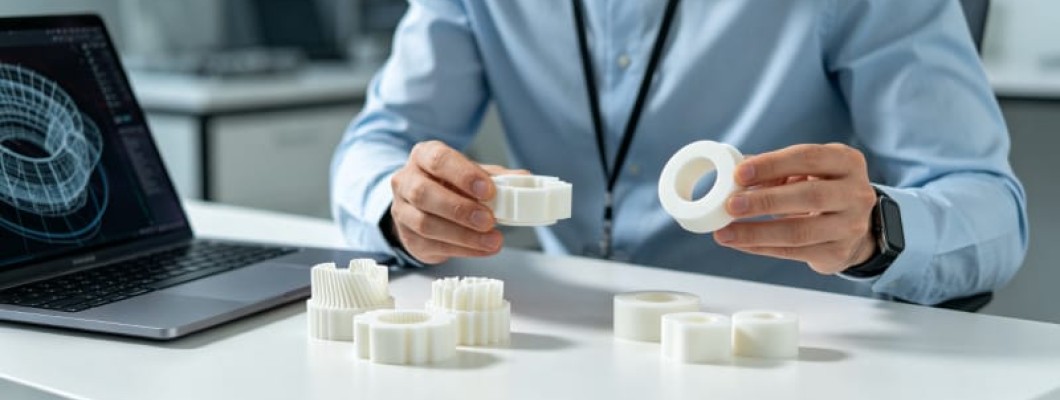
SLA versus FDM starts with what the part must do
The SLA versus FDM question is rarely about which technology is better in the abstract; it is about which one matches the job the part has to perform. stereolithography 3d printing wins when fine detail, smooth surfaces and tight small features dominate, while filament-based FDM is the stronger pick for tough, large or low-cost functional parts. Choosing before defining function, environment and finishing needs is how buyers end up paying for resolution they do not need, or receiving a part too rough for its purpose.
HUANYA treats process selection as an engineering decision, not a sales default. When a file arrives, we look at critical dimensions, mating faces, expected loads, operating temperature, cosmetic requirements and quantity, then recommend SLA, FDM or a combination such as an FDM functional build alongside an SLA appearance model. The result is a process choice that follows the part, not the other way around.
How each process actually builds a part
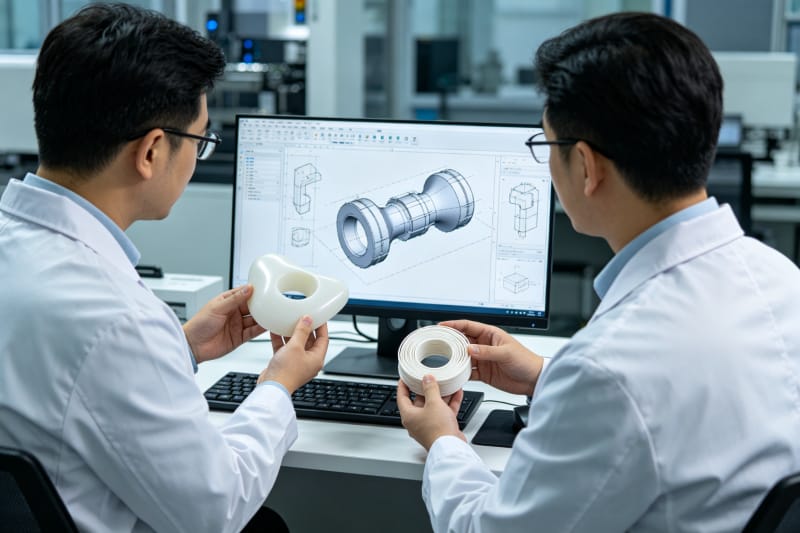
Fused deposition modeling extrudes a melted thermoplastic filament through a heated nozzle, depositing road after road onto the build plate; SLA cures liquid photopolymer resin layer by layer with UV light. That single difference explains most of what follows: the thermoplastic part inherits visible layer lines and direction-dependent strength, while the resin part gains a smooth surface and very fine features but requires washing, support removal and a controlled UV post-cure. Table 1 compares the parameters buyers actually ask about; all tolerance figures are industry-typical ranges whose achievable value depends on geometry, material and post-processing and is confirmed during DFM review.
Attribute | FDM | SLA |
Build principle | Heated nozzle extrudes melted thermoplastic filament layer by layer | UV light cures liquid photopolymer resin layer by layer |
Typical layer height | 0.10–0.30 mm with a common 0.4 mm nozzle | 0.025–0.10 mm |
Typical tolerance* | ±0.5% with a ±0.5 mm floor | ±0.1% with a ±0.1 mm floor |
Minimum wall thickness | roughly 0.8–1.2 mm | roughly 0.4–0.6 mm |
Smallest practical detail | limited by nozzle, about 0.4–0.8 mm | fine detail around 0.2–0.3 mm |
Material families | PLA, ABS, ASA, PETG, PC, nylon, TPU thermoplastics | rigid, tough, flexible, clear and castable photopolymers |
As-printed surface | visible layer lines, anisotropic strength | smooth, low stepping; needs UV post-cure |
Support evidence | removable supports, larger contact marks | small nubs, light sanding |
Surface finish and fine detail: where SLA leads
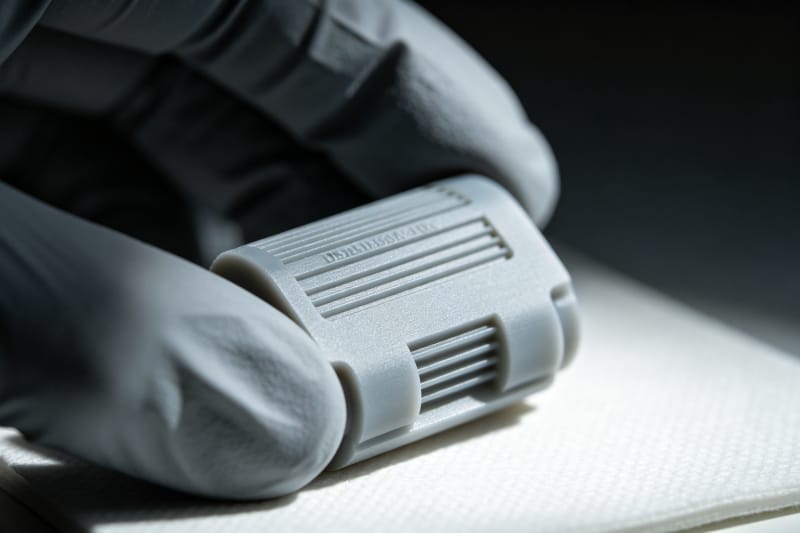
When a prototype will be shown to investors, used as an ergonomic model, painted for an exhibition, or turned into a silicone vacuum-casting master, SLA has a clear advantage. Its thin layers reproduce ribs, text, logos, textured surfaces and small radii that an FDM nozzle would round off or staircase. As-printed SLA surfaces need far less filling and sanding before painting, which shortens the cosmetic finishing route and preserves the designer's intended shape.
SLA is also the natural choice for transparent and light-transmitting parts. Clear resins can be polished into light guides, lenses, fluid-flow demonstrators and housings where internal components must stay visible. Flexible and castable resins extend the same detail advantage to soft-touch components and investment-casting patterns. If the brief is dominated by appearance, micro-features or smooth curvature, SLA removes work rather than creating it.
Strength, materials and environment: where FDM leads
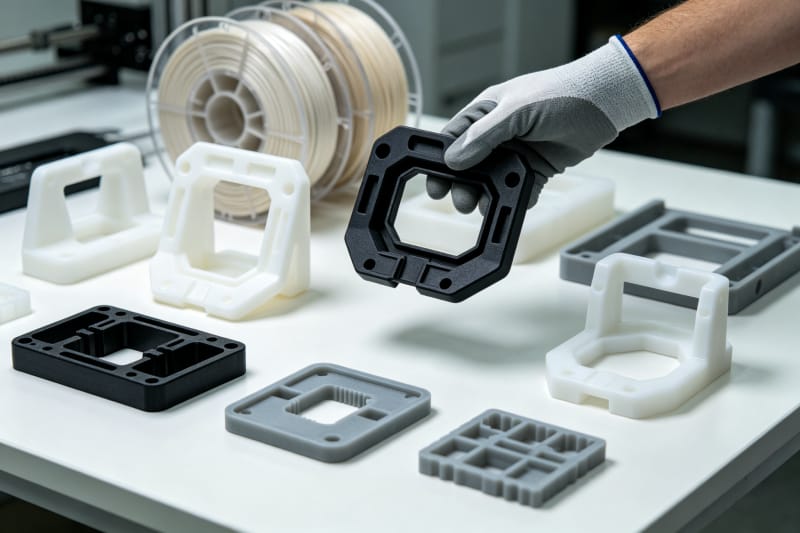
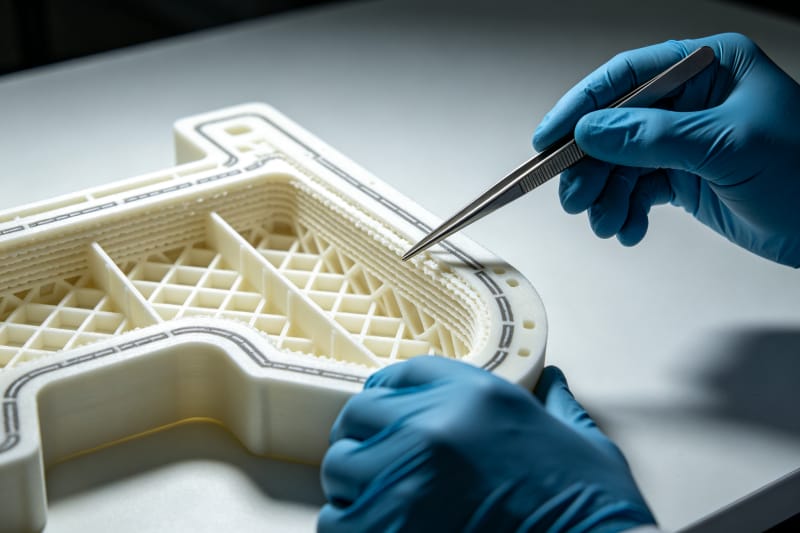
For parts that must carry load, snap into place, resist heat or survive outdoor exposure, fdm 3d printing draws on a much wider range of engineering thermoplastics. ABS and ASA handle impact and UV, PETG balances toughness and ease of printing, PC offers heat resistance, nylon provides wear and fatigue performance, and TPU delivers elasticity. These are real production-grade polymers, not only appearance materials, which is why jigs, fixtures, brackets and housings so often default to FDM.
Direction matters in FDM: bonds between layers are weaker than the material along the extrusion path, so load-bearing walls should be oriented so forces travel within layers or across dense infill. HUANYA sets wall count, infill density, raster direction and perimeters to the application, and adds fillets at stress concentrations. With the right settings, an FDM part can be used as a working component rather than a static display model.
FDM also scales more economically to large dimensions and bulky volumes, because filament materials cost less per kilogram than photopolymers and large machines run without resin tank limits. SLA remains preferable when the same large part needs a perfectly smooth skin; in that case buyers sometimes split the decision, using FDM for the structural version and SLA for the cosmetic master. Table 2 turns these trade-offs into a quick selection map.
Project requirement | Recommended | Why |
Large housings, jigs, low-cost functional checks | FDM | Low-cost thermoplastic, large build volume, good toughness |
Heat, outdoor UV, impact or chemical exposure | FDM (ABS / ASA / PC / nylon) | Engineering thermoplastics match the environment |
Fine detail, small features, textured master patterns | SLA | High resolution reproduces tiny geometry smoothly |
Clear, light-transmitting or lens-like parts | SLA | Transparent resins are polishable to optical-like clarity |
Master for silicone vacuum casting | SLA | Smooth surface captures fine texture for moulding |
Repeated flex, snap fits or living hinges | FDM (PETG / TPU / PP-like) | Standard resin is more brittle unless a tough grade is chosen |
Cosmetic show and ergonomic models | SLA | Smooth as-printed finish reduces finishing work |
Cost, speed and size in real production orders
On a like-for-like small part, SLA often looks comparable in price, but the economics diverge as volume and size grow: FDM material is cheaper, machines run unattended in parallel, and bulky parts cost far less in filament than in resin. SLA, by contrast, spends its budget where it creates value — resolution and surface quality — so it is most cost-effective on smaller, detailed parts rather than large empty enclosures. A trustworthy quote states both routes when the choice is genuinely close.
Accuracy expectations should follow the same logic. Buyers who need a ±0.1 mm bore or a fine thread form lean on SLA or a secondary machining step; buyers who need a ±0.5 mm housing bracket get there faster and cheaper with FDM. Inconsistent dimensional accuracy between batches — the frustration that makes overseas ordering feel risky — does not occur at HUANYA: machines are calibrated on a fixed schedule, material lots are tracked and critical dimensions are measured before shipment.
Post-processing that stays consistent
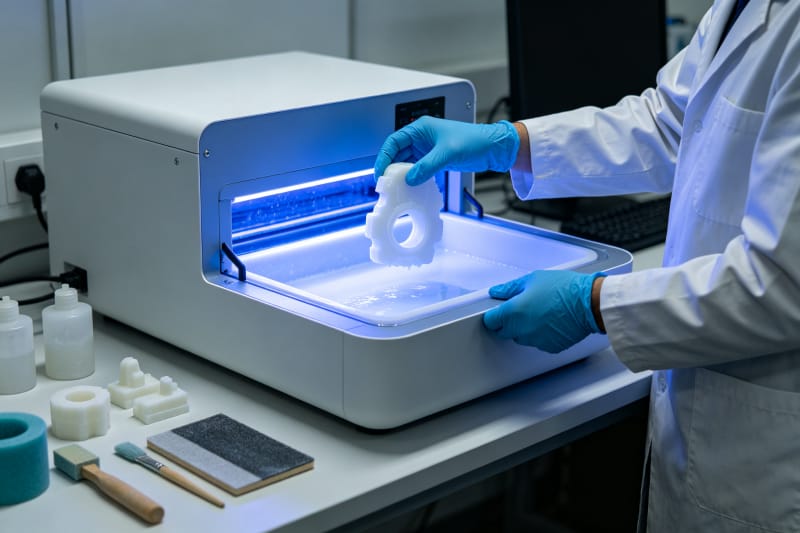
A professional sla printing service knows that SLA parts are not finished when the build ends: they need washing to remove residual resin, controlled support removal, UV post-curing to reach final properties, and then sanding, polishing or painting as specified. FDM parts follow a different route — support removal, bead blasting or sanding to soften layer lines, optional vapor smoothing, priming and painting. Choosing the process early means the finishing route and its cost are planned rather than improvised.
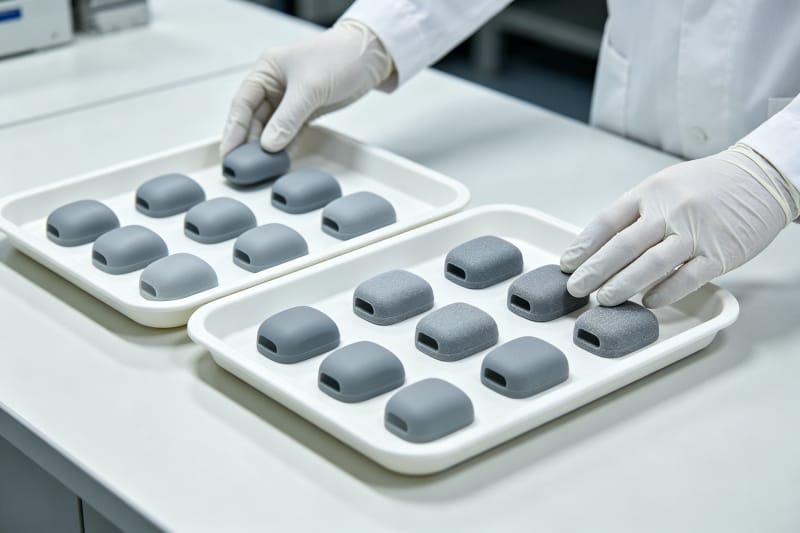
Batch-to-batch variation in finishing is one of the three problems HUANYA customers simply do not meet. Documented settings — cure time, sanding grit sequence, paint thickness and colour recipe — keep an SLA master and its reorders visually identical, and keep FDM parts with the same surface roughness whether produced this month or next. What looks correct on the approved first article is what every later unit reproduces.
Lead-time and reorder reliability
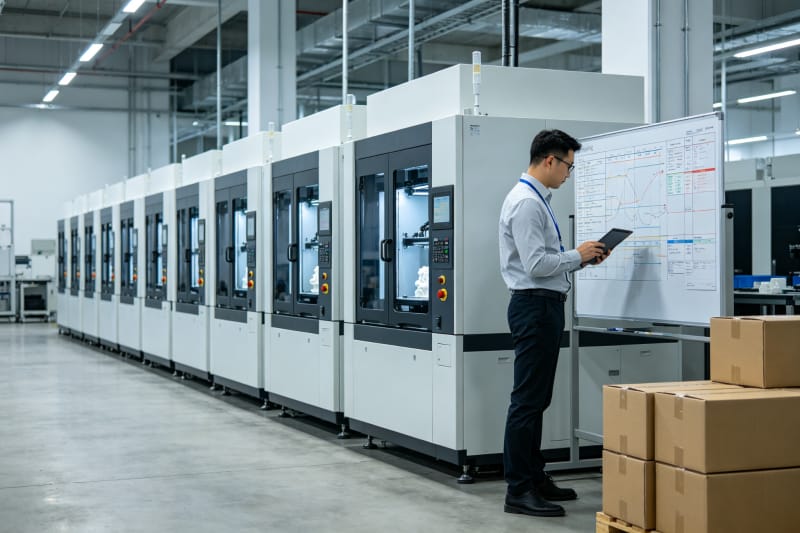
Both processes are fast compared with tooling-based manufacturing, but they spend time differently. FDM needs little setup and parallel machines absorb quantity quickly; SLA adds wash and post-cure stages that must be scheduled. HUANYA quotes production time and shipping time separately, reserves machine capacity on order confirmation and schedules against the actual carrier pickup date, so silent queues and last-minute outsourcing never push the delivery date without warning.
For repeat orders, HUANYA stores the full production record — process, orientation, material grade, parameters, finish recipe and inspection results — against the customer file. A reordered SLA or FDM part therefore matches the first batch dimensionally and cosmetically, and design teams can mix processes across revisions without losing traceability. Reliable reorders remove the need to re-qualify the supplier on every purchase.
Choose with HUANYA
Send your model and tell HUANYA how the part will be used, loaded, finished and ordered; we recommend SLA for detail and smooth surfaces, FDM for tough, large or economical functional parts, or a hybrid plan when a project needs both. You receive an engineer-reviewed quote, realistic tolerances, consistent finishing and a confirmed lead time — so the process you choose is the one your part actually needs.


Leave a Comment