
 English
 French
 Deutsch
 العربية
 Español
 Русский
 にほんご
にほんご Português
 한국어
한국어
05 Sep
Durability Challenges in 3D Printed Test Vehicle Parts
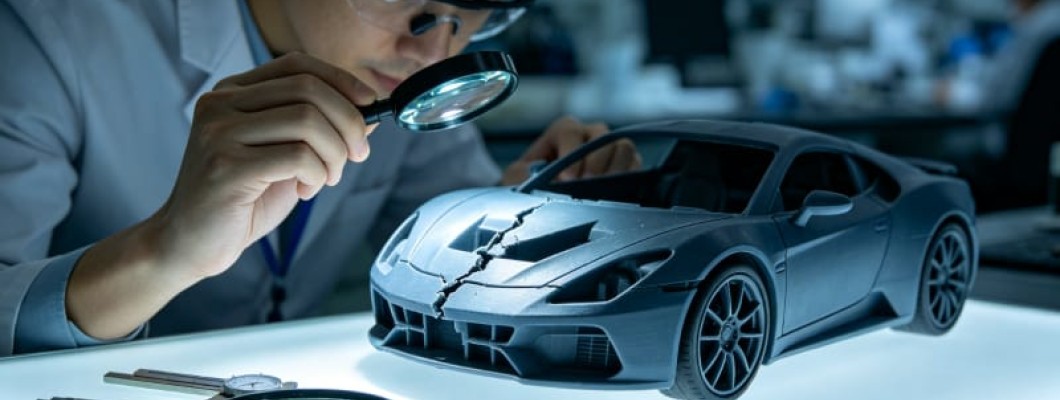
Test vehicles operate under conditions that push every component to its limit—engine bay heat cycling, vibration from road surfaces, repeated mechanical loading, and exposure to oils, fuels, and cleaning chemicals. When engineering teams turn to 3d printing automotive parts for test mules and validation vehicles, the parts must survive these conditions long enough to generate meaningful test data, not just look correct on a bench. A dashboard bracket that cracks after fifty hours of vibration testing, or an intake manifold that warps under sustained under-hood temperatures, invalidates an entire test cycle and wastes weeks of scheduling. At HUANYA, we understand that automotive 3d printing is not about printing a shape—it is about producing a component that performs reliably under the specific loads and environments the test program demands.
The most common failure modes in 3d printed car parts are predictable if you know where to look. Layer delamination occurs when the bond between printed layers is weaker than the bulk material, typically caused by insufficient chamber temperature or poor layer adhesion in semi-crystalline materials like nylon. Heat distortion happens when a part printed in a material with a low heat-deflection temperature is placed near an engine or exhaust component. Chemical swelling affects parts exposed to gasoline, diesel, brake fluid, or transmission oil if the material was not selected for fluid resistance. Fatigue failure at stress concentrations—sharp corners, thin ribs, mounting holes—shows up after repeated loading cycles. Addressing each of these failure modes requires the right combination of material selection, print orientation, post-processing, and validation testing, which is exactly what a qualified rapid prototyping automotive partner brings to the program.
Material Selection for Automotive Durability Requirements
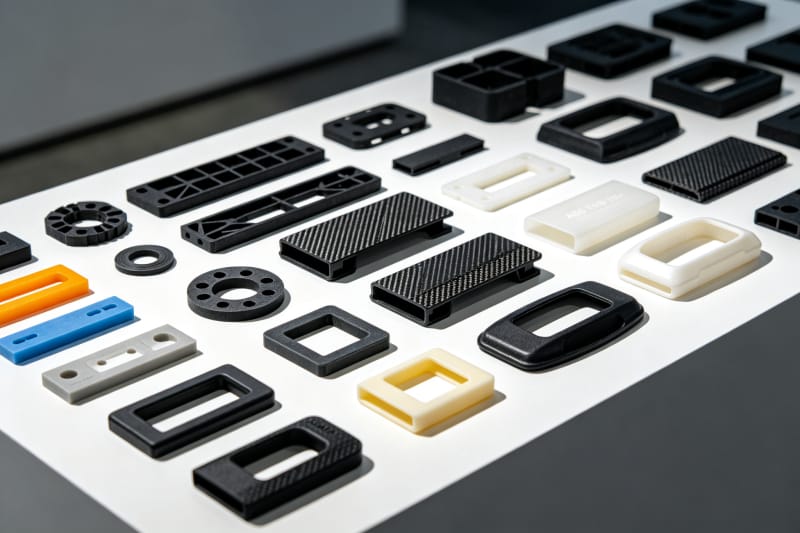
Choosing the right material is the single most important decision in 3d printing automotive parts that survive testing. For under-hood components facing sustained temperatures of 80 to 120 degrees Celsius, materials like PA12 nylon (SLS/MJF) and high-temperature PETG offer good heat resistance combined with chemical resistance to oils and fuels. For structural brackets and load-bearing mounts, carbon-fiber-reinforced nylon or PEKK provide stiffness and strength that approach aluminum at a fraction of the weight. For interior trim and dashboard components where impact resistance and surface finish matter, ABS and ASA deliver consistent performance with UV stability for parts that may see sunlight through the windshield. For flexible components like seals, grommets, and vibration isolators, TPU in shore hardnesses from 60A to 95A matches the performance of cast urethane parts.
Material selection must also account for the testing environment. A part destined for cold-weather testing in Scandinavia needs a material that remains ductile at minus 30 degrees Celsius, while a part for desert testing must resist UV degradation and sustained high heat. Fluid compatibility is non-negotiable for any component in the fuel, brake, or lubrication system. At HUANYA, we maintain a material library specifically for automotive 3d printing applications, with documented data on heat deflection temperature, tensile strength, impact resistance, chemical compatibility, and fatigue behavior for every material we offer. We work with your engineering team to match the material to the test conditions, not just to the CAD geometry, ensuring that 3d printed car parts perform as expected from the first test lap to the last.
Process Optimization and Validation for Durability
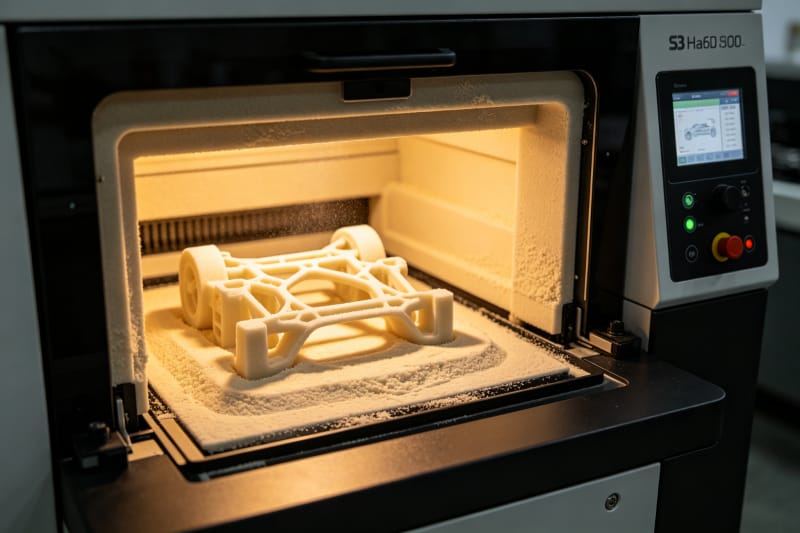
Even the best material will fail if the printing process is not optimized for durability. Layer orientation is critical—parts printed with layers perpendicular to the primary load direction are inherently weaker in that direction. We orient every automotive component so that load-bearing features align with the strongest axis of the print, and we add fillets and radius transitions in high-stress areas during the DFM review. Chamber temperature control is essential for semi-crystalline materials; a stable, elevated chamber temperature ensures full layer fusion and minimizes internal stresses that cause warping and delamination. For SLS and MJF nylon parts, we control powder refresh ratios and build temperatures to ensure consistent material properties across the entire build volume, not just in ideal positions.
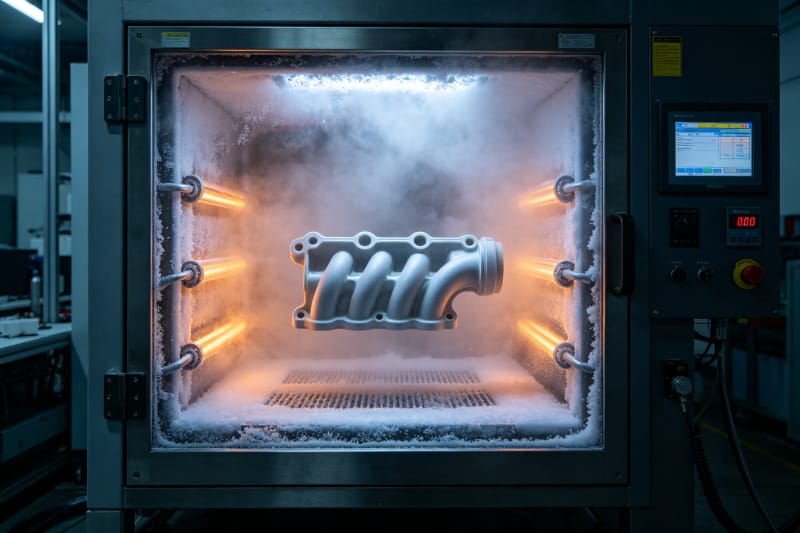
Validation is where many rapid prototyping automotive programs fall short. At HUANYA, we do not just print and ship—we verify that parts meet the required mechanical specifications before they reach your test vehicle. This includes dimensional inspection with coordinate measuring machines to confirm critical tolerances, tensile test bars printed alongside production parts to verify material properties, and thermal cycling tests for components exposed to temperature extremes. We can also perform vibration testing, fluid immersion tests, and UV exposure testing on request. Every batch comes with material certificates and inspection reports, so your engineering team has full traceability and confidence that the parts will perform as specified. The goal is simple: when you install a 3d printed component on a test vehicle, it should behave like the production part it represents, not like a fragile prototype.
From Prototype to Test Vehicle Validation
The path from a CAD model to a validated test vehicle component starts with a clear understanding of the test objectives. Is the part being used for fit and form verification, functional testing, or durability cycling? Each objective carries different requirements for material, finish, and validation rigor. HUANYA assigns a dedicated engineer to every automotive program, who reviews the test plan, identifies critical load paths and environmental exposures, and recommends the optimal material and process before printing begins. We also produce first-article parts for your team to inspect and approve before committing to a full test-vehicle set, eliminating surprises and ensuring that every part that goes on the vehicle meets your acceptance criteria.
Once the design and material are validated, we scale to full test-vehicle quantities with the same equipment, process parameters, and quality controls. Whether you need five intake manifolds for a single test mule or fifty bracket sets for a fleet of validation vehicles, our automotive 3d printing workflow delivers consistent parts on schedule. We understand that test programs have hard deadlines and that a delayed part can idle an entire vehicle program, so we prioritize automotive orders with dedicated production capacity and expedited shipping. When durability matters and test schedules are tight, HUANYA is the partner that delivers 3d printing automotive parts you can trust on the test track. Contact us today with your test vehicle requirements and receive a material recommendation and quote within one business day.


Leave a Comment