
 English
 French
 Deutsch
 العربية
 Español
 Русский
 にほんご
にほんご Português
 한국어
한국어
11 Aug
The Cost Revolution Nobody Expected
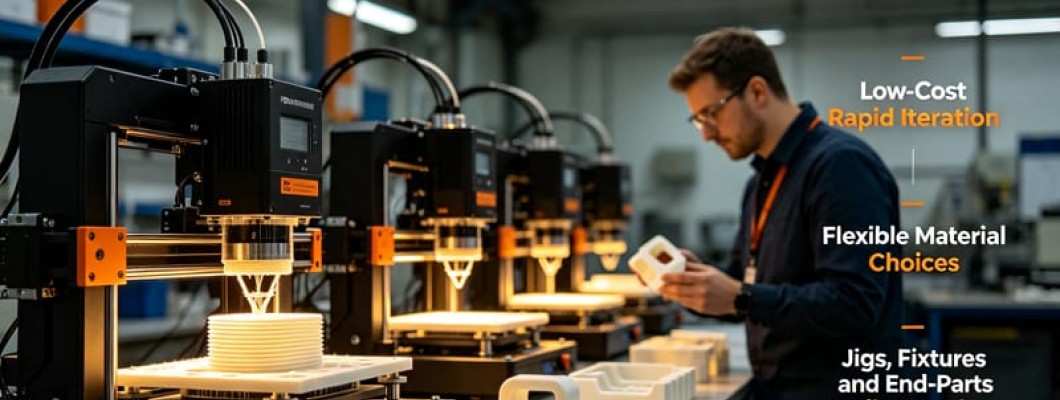
When traditional manufacturing forces you to commit to thousands of units just to hit a reasonable per-part price, FDM 3D printing tears that rulebook apart. At HUANYA3D, we have seen hundreds of B2B clients slash their production budgets by up to seventy percent by switching to small batch 3d printing. The math is brutal but beautiful: no expensive molds, no minimum order quantities that strangle cash flow, and no wasted material sitting on warehouse shelves. Every dollar you spend goes directly into the parts you actually need, not into tooling that becomes obsolete the moment your design changes.
Consider the automotive startup that needed five hundred custom bracket prototypes. With CNC machining, the quote exceeded forty thousand dollars and took six weeks. With our fdm 3d printing service, the same parts shipped in five days for under eight thousand. This is not incremental improvement; this is a complete reset of what small batch manufacturing costs. Companies that ignore this shift are not just losing margin; they are losing the ability to iterate fast enough to survive in markets where speed equals survival.
The economics get even more compelling when you factor in design freedom. FDM technology lets you consolidate multiple assembled components into a single printed part, eliminating fasteners, reducing assembly labor, and improving structural integrity. A housing that used to require three machined pieces and twelve screws now prints as one unified unit. Our custom 3d printing service clients routinely report total cost reductions that go far beyond the print itself, touching assembly, inventory, and logistics across the entire supply chain.
Speed That Rewrites Production Timelines
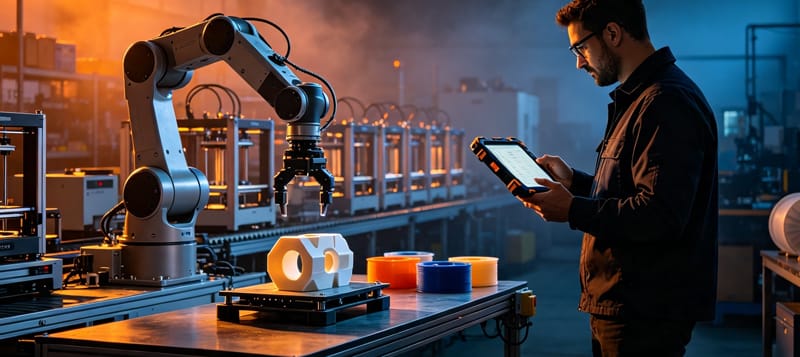
In the old manufacturing paradigm, "fast" meant six weeks. With rapid prototyping powered by FDM, "fast" means forty-eight hours. HUANYA3D operates a fleet of industrial-grade FDM printers running around the clock, so your project moves from approved CAD file to shipped parts in days, not months. This speed is not a luxury; it is a strategic weapon that lets your engineering team test five design iterations in the time competitors take to get one quote back from a traditional machine shop.
We recently worked with a medical device company racing to meet a regulatory submission deadline. They needed three hundred ergonomic handle enclosures with specific texture requirements. Our small batch 3d printing line produced the entire run in four days, including post-processing and quality inspection. They submitted three weeks ahead of schedule and secured their market entry window. Stories like this are not exceptions at HUANYA3D; they are the standard outcome when you combine the right technology with obsessive operational discipline.
The speed advantage compounds across your entire product development cycle. You can validate form, fit, and function simultaneously. You can run customer validation with functional prototypes before committing to hard tooling. You can even bridge production during tooling transfers or supply chain disruptions. FDM 3d printing does not just make parts faster; it makes your entire organization faster, more agile, and more responsive to whatever the market throws at you next.
Material Freedom for Every Engineering Challenge
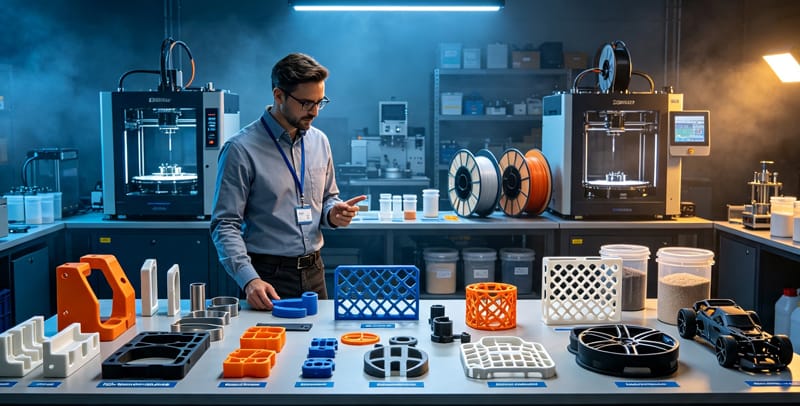
One of the most underestimated advantages of FDM technology is its breathtaking material versatility. At HUANYA3D, our custom 3d printing service supports PLA, ABS, PETG, TPU, ASA, PC, and carbon-fiber reinforced composites, each chosen for specific mechanical, thermal, and environmental requirements. Whether you need a heat-resistant under-hood automotive component, a flexible consumer product grip, or a chemically resistant industrial fixture, there is an FDM material engineered for exactly that application.
Take carbon-fiber reinforced PETG, for example. It delivers stiffness comparable to aluminum at a fraction of the weight and cost, making it ideal for robotics end-effectors, drone frames, and lightweight structural brackets. We have seen aerospace clients replace machined aluminum components with carbon-fiber FDM parts, reducing weight by sixty percent while maintaining required strength tolerances. This is not hobbyist printing; this is industrial-grade material science delivered through accessible fdm 3d printing technology.
Material choice directly impacts your bottom line. Engineering-grade ABS withstands temperatures up to one hundred degrees Celsius, perfect for automotive and electronics enclosures. TPU offers shore hardness options from flexible rubber-like to semi-rigid, opening applications in footwear, seals, and ergonomic grips. ASA provides superior UV resistance for outdoor use. With small batch 3d printing, you can test multiple materials in parallel without committing to expensive material-specific tooling, finding the optimal solution faster and cheaper than any traditional method allows.
Why B2B Leaders Are Making the Switch
The decision to adopt FDM 3d printing is no longer a question of "if" but "how fast." Companies across automotive, aerospace, medical, consumer goods, and industrial equipment are restructuring their supply chains around additive manufacturing because the competitive gap is becoming too wide to ignore. HUANYA3D has partnered with over five hundred B2B clients worldwide, and the pattern is consistent: those who embrace small batch 3d printing early capture market share, while late adopters struggle to match their speed and cost structure.
Quality control is where many cheap 3D printing services fail, and where HUANYA3D deliberately differentiates. Every part we produce undergoes dimensional verification, layer adhesion inspection, and material traceability documentation. Our fdm 3d printing process is calibrated to achieve tolerances as tight as plus or minus zero point one millimeters, with surface finish options ranging from functional as-printed to smooth sanded and painted. When you choose our custom 3d printing service, you are not just buying parts; you are buying a manufacturing partner that understands B2B quality expectations and delivery commitments.
The future belongs to companies that can turn ideas into physical products faster than their competitors. FDM 3d printing is the most accessible, cost-effective, and versatile technology to make that happen. Whether you need ten functional prototypes or five thousand production-grade parts, HUANYA3D has the capacity, expertise, and material selection to deliver. Stop paying for molds you do not need and waiting for lead times that kill momentum. Request a quote today and discover what small batch 3d printing can do for your bottom line.


Leave a Comment