
 English
 French
 Deutsch
 العربية
 Español
 Русский
 にほんご
にほんご Português
 한국어
한국어
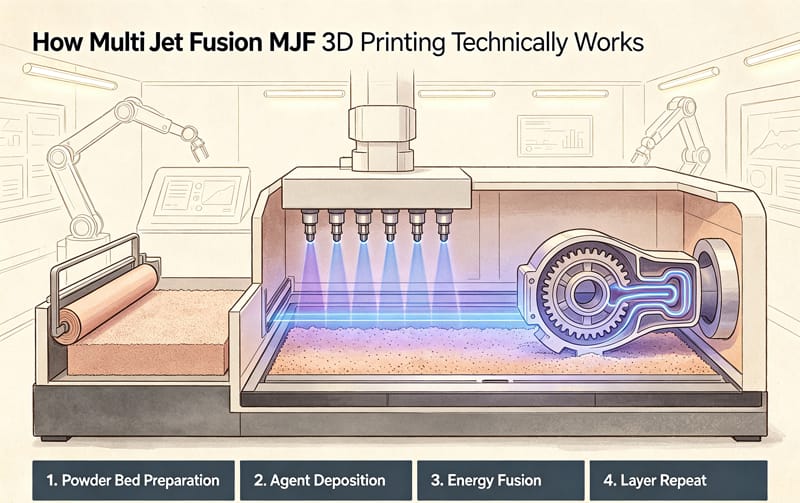
How Multi Jet Fusion MJF 3D Printing Technically Works
Multi Jet Fusion is a powder‑bed polymer 3D printing technology different from laser‑based SLS. Industrial print heads spray fusing agents and detailing agents across each powder layer, followed by full‑surface infrared heating to fuse target areas without building physical support structures. At HUANYA, our MJF industrial equipment nests dozens of different components within one build chamber to boost 3D printing throughput. Recyclable powder material helps keep costs reasonable for small‑volume orders. Parts achieve near‑isotropic mechanical behaviour, avoiding weak inter‑layer defects common in some other 3D printing workflows, so functional test results closely reflect real‑world working conditions for your engineering projects.
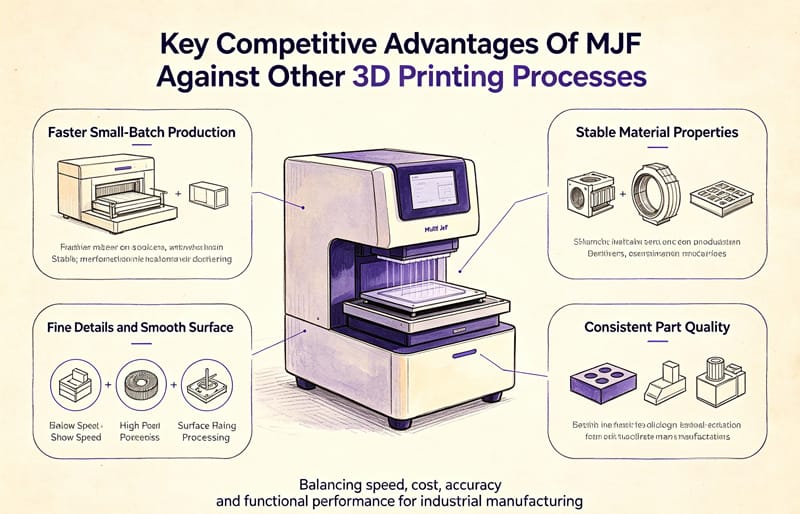
Key Competitive Advantages Of MJF Against Other 3D Printing Processes
Many industrial buyers struggle to choose between MJF, SLS and FDM. MJF stands out for consistent batch quality and fast build speed, printing two to three times faster than conventional SLS technology for small‑to‑medium runs. HUANYA delivers finished MJF components with full post‑processing including depowdering, bead blasting and dyeing. Compatible materials cover PA12, PA11, glass‑filled nylon and flexible TPU. Complex hollow channels, living hinges and snap‑fit assemblies can be manufactured in one single piece. Unlike injection moulding, MJF removes expensive tooling investment, you can revise product geometry without mould rework and cut risk during new‑product research phases.
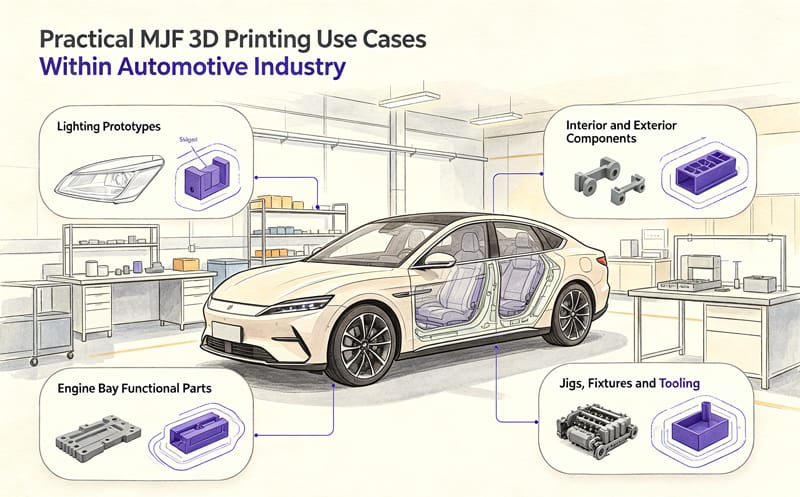
Practical MJF 3D Printing Use Cases Within Automotive Industry
Automotive engineering represents one of the most proven markets for MJF 3D printing. OEM and tier‑one suppliers rely on this additive manufacturing method for interior functional assemblies, cooling ducts and sensor brackets in limited production runs. One new‑energy vehicle development team cooperated with HUANYA to produce vent housings and clip components via MJF. Those curved internal channels would be extremely hard for CNC machining, while injection moulding was economically unviable for low prototype quantities. Thanks to 3D printing MJF technology, dozens of functional units arrived within days for real‑vehicle vibration and durability testing, shortening validation cycles and accelerating vehicle development schedules.
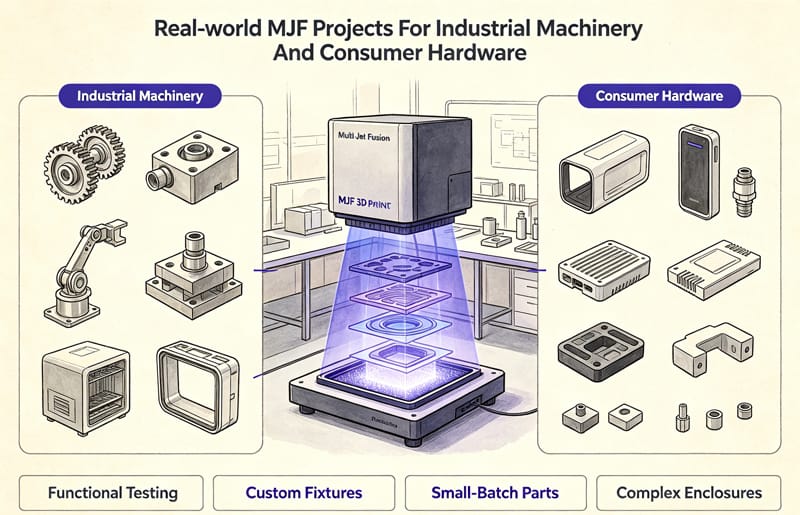
Real‑world MJF Projects For Industrial Machinery And Consumer Hardware
Factory automation hardware and smart consumer devices frequently adopt MJF 3D printing for jigs, enclosures and flexible snap‑joints requiring high toughness, impact resistance and repeatable dimensional accuracy. An automation equipment manufacturer ordered two hundred quick‑release latches. Components needed repeated assembling cycles and solid impact performance. After comparing multiple manufacturing routes, they selected HUANYA3D MJF 3D printing solution. Final parts delivered uniform mechanical properties with minimal batch‑to‑batch deviation. No tooling expenditure was required, updated iterations were produced rapidly after design tweaks, perfectly fitting new‑product development and on‑demand spare‑part workflows for machinery companies.
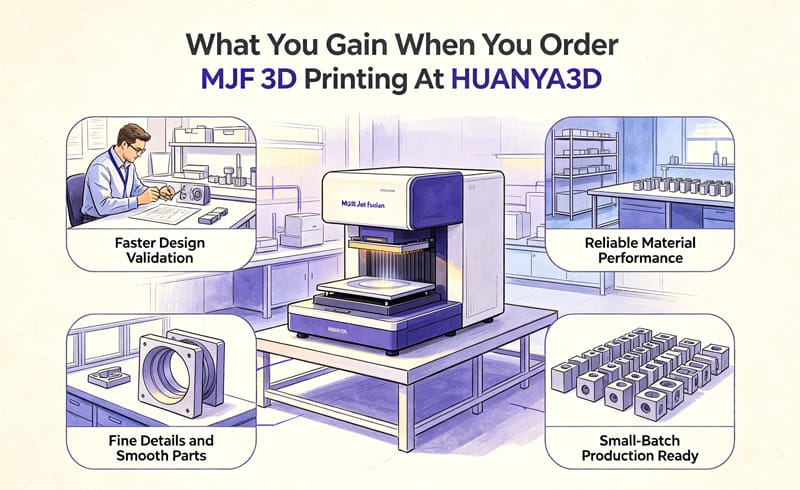
What You Gain When You Order MJF 3D Printing At HUANYA3D
Poor design choices often lead to MJF part failures. HUANYA’s process engineers conduct free manufacturability reviews once you upload 3D files, pointing out risks on thin walls, sharp corners and hollow geometries. Our complete workflow covers drawing evaluation, MJF printing, post‑treatment and quality inspection, supporting prototype samples as well as mid‑volume end‑use components. We accept orders from several test pieces up to hundreds‑unit batches. Send your CAD files today and get an accurate quotation to move your hardware project forward efficiently.


Leave a Comment