
 English
 French
 Deutsch
 العربية
 Español
 Русский
 にほんご
にほんご Português
 한국어
한국어
Common material pitfalls for 3D printed automotive components
Many B‑side engineers new to automotive 3D printing pick generic low‑grade polymers and end up with parts that warp under heat, crack when exposed to oil or degrade quickly under sunlight. Automotive components survive harsh operating conditions including high temperature, chemical exposure, mechanical vibration and UV radiation. Basic desktop‑grade polymers such as PLA cannot withstand real‑world vehicle operating environments. From numerous low‑volume custom projects handled by HUANYA3D, roughly 80 % of failed automotive print jobs stem from poor material selection rather than printing quality. Even high‑precision 3D printing output becomes useless if the polymer cannot match service conditions. For R&D prototypes, spare‑part batches and custom vehicle modifications, correct material choice outweighs chasing the lowest unit price.
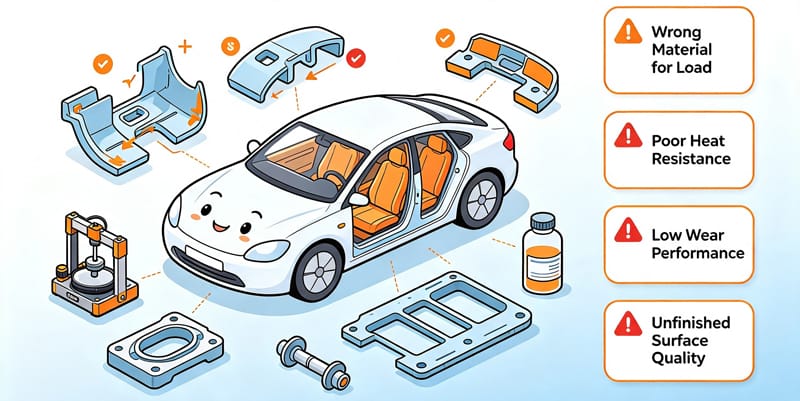
PA12 nylon, ASA, TPU, ABS and carbon‑fiber‑reinforced polymers dominate real‑world low‑volume automotive 3D printing. PA12 delivers great oil resistance, impact performance and low moisture absorption for clips, tube brackets and chassis components, commonly manufactured via MJF or SLS 3D printing for new‑energy vehicle prototypes. ASA brings outstanding UV‑resistance for mirror housings and exterior trims without yellowing under long‑term sunlight. Flexible TPU produces gaskets and shock‑absorbing elements, while ABS works well for interior mock‑ups. Carbon‑fiber filled grades boost stiffness for lightweight metal‑replacement brackets. When processing automotive 3D‑print orders, HUANYA3D evaluates working conditions first to recommend proper polymers and prevent expensive rework caused by wrong‑material decisions.
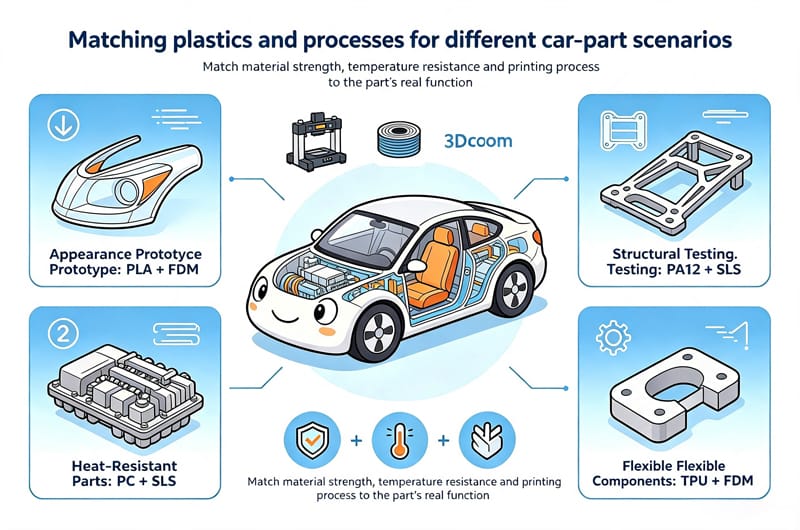
Interior trim parts prioritize surface finish and moderate heat tolerance, making ASA and ABS solid options. Components near engine assemblies demand heat‑and‑oil resistance, so PA12 or carbon‑fiber‑filled nylon should be prioritized. Exterior parts require UV‑stable polymers; standard non‑UV‑resistant ABS must be avoided. Flexible TPU serves seals and damping elements. Distinguish between visual prototypes and end‑use functional parts: mock‑ups tolerate looser material standards, while serial low‑volume parts need verified thermal‑deformation and chemical‑resistance data. Identical plastic yields different mechanical results across FDM, SLS and MJF workflows. HUANYA3D offers free material‑selection assessment for B‑business customers, delivering practical polymer recommendations to cut trial‑and‑error risks for small‑batch manufacturing.
Traditional injection molding requires expensive tooling investment; 3D printing skips mould costs for batches ranging from dozens to hundreds of automotive components. Yet you cannot simply copy injection‑molding material specifications for additive manufacturing. Some injection‑grade polymers perform poorly on 3D‑printing platforms. Real‑world engineering cases show that injection‑molding‑grade PA6 often causes heavy warpage and unstable dimensional consistency in powder‑bed 3D printing. Always reference proven automotive additive‑manufacturing case histories and select field‑validated engineering polymers. Whether you develop vehicle prototypes, modified‑car accessories or discontinued‑model spare parts, HUANYA3D one‑stop 3D print service covers drawing review, material consulting and post‑processing. Send your CAD files for a professional quotation.


Leave a Comment