
 English
 French
 Deutsch
 العربية
 Español
 Русский
 にほんご
にほんご Português
 한국어
한국어
What under-extrusion looks like and why it matters
Under-extrusion is the quiet defect that kills otherwise correct-looking parts: the printer lays less plastic than the slice calls for, so roads turn thin, gaps open between adjacent lines, and walls stop being solid. To the naked eye a small bracket may still read as "printed", but its layer lines look sparse and stringy, and a finger tap gives a hollow, tinny sound rather than a solid one. 3d printing under extrusion is the single most common reason a dimensionally perfect-looking FDM part still fails its function.
For production buyers the stakes are not cosmetic. A wall that is only 70% filled carries perhaps 60–70% of the expected strength, and thread bosses flex, press fits slip, and housings crack where they were designed not to. In fdm 3d printing, where the part strength comes almost entirely from the bonds between those roads, missing material is not a surface complaint — it is a structural one. That is why a professional build does not treat the symptom after printing; it prevents it before the first layer.

The main mechanical causes behind under-extrusion
Most under-extrusion traces to a short list of failures in the extrusion path. A partially clogged nozzle cuts the melt stream; a worn extruder drive gear grinds the filament instead of pushing it; an undersized retraction or a loose idler lets the gear spin in place. Each leaves a different fingerprint on the part, and an experienced operator reads those fingerprints instead of re-running blindly. The table below maps the typical cause to its visible sign and the control HUANYA applies on every production build.
Cause | Typical visible sign | HUANYA control on every build |
Partially clogged nozzle | Thin, wavering roads starting mid-print | Nozzle cleaning routine and scheduled replacement |
Worn extruder drive gear | Random under-extrusion, filament shavings in the gear | Gear inspection and replacement log per machine |
Wrong/low melt temperature | Cold, weak lines that do not fuse | Material-specific temperature profiles locked per part |
Diameter mismatch or badly tangled spool | Sudden thin sections after a spool change | Calibrated filament runout check before each job |
Wet filament | Popping, hissing and bubbles mid-road | Drying station with logged moisture check |
Flow/stepper miscalibration | Systematically thin walls on every part | Periodic extrusion multiplier calibration |
Material and environment causes
Mechanics explain half the problem; material condition explains the other half. Hygroscopic filament — nylon, PETG, TPU — absorbs ambient moisture even in a sealed bag once opened, and that water flashes to steam in the melt chamber. The result is audible popping, blobs of unsupported filament, and roads that look "spitty" rather than smooth. A part printed wet looks under-extruded and weak, even though the machine is perfectly adjusted.
Environment matters too. A cold draft under an open gantry cools the melt before it bonds, and a damp summer week in an unconditioned room does in hours what a dry box prevents. In a production fused deposition modeling line these are not surprises; they are scheduled checks, logged before the machine starts, the way a print farm dries material and records ambient temperature per shift rather than hoping the shop happens to be dry.
How under-extrusion changes the part: strength, surface and cost
The first victim is strength. Road width is what gives a wall its section; if the printer deposits 80% of the planned width, the effective wall area falls, and tensile and bending loads concentrate at the few bonded bridges that remain. Snap fits and living hinges that were designed to flex thousands of cycles break on the first bend. The engineering margin that a buyer sized in CAD quietly disappears.
The second victim is surface and dimension. Gaps between roads expose the infusion lattice to sight, so a part that should look finished looks porous; undersize walls mean a press fit that never grips and a tapped hole that strips. Then comes the third cost: the buyer's own hours. A batch of visually imperfect brackets gets rejected, re-quoted and re-run, and the project pays twice — once for the bad build, once for the week it cost.
Table 2 pairs each visual fingerprint with what it actually does to the part, and at which HUANYA checkpoint it is caught. Numbers below are typical engineering observations, confirmed on the actual print, not universal laws.
Fingerprint on the part | Mechanical consequence | Caught at HUANYA |
Visible gaps between roads | Lower effective wall section, higher gas permeability | First-article visual inspection |
Thin, wavering walls | Press fits and threads lose holding strength | Dimensional check on critical bores |
Bubbles / pops on the surface | Stress concentration, premature crack paths | Material drying log pre-job |
Delaminated layers | Near-zero strength across layers, separates on load | Adhesion check before release |
Hollow "tinny" tap sound | Internal infill not bonded, part over-designated | Sample section cut when required |
How a production line prevents it before the first layer
Prevention starts long before slicing. Every material lot that enters HUANYA goes through a drying step sized to that polymer, and the dry state is logged rather than assumed. The extruder gears, nozzles and idlers are on a maintenance schedule tied to machine hours, so a worn part is replaced on the calendar, not after it has quietly ruined a batch of customer geometry.
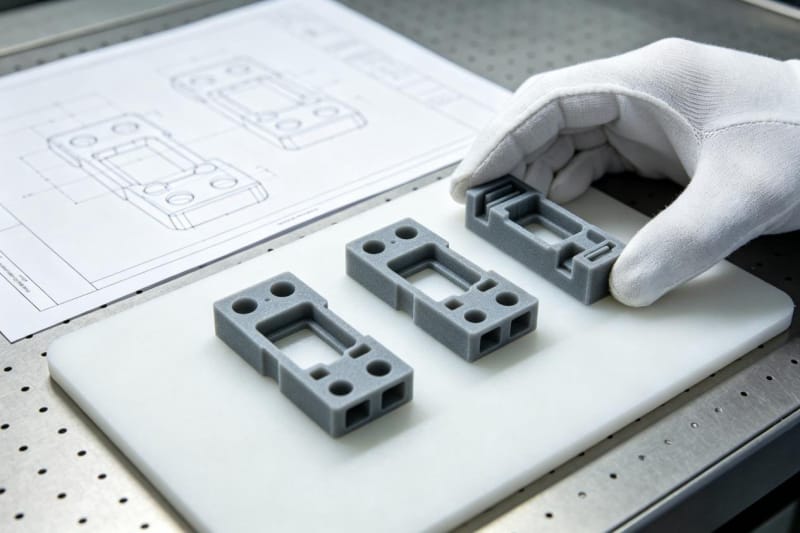
The slicer profile is locked per approved part: temperature band, flow multiplier, retraction and wall count are not "whatever default the operator remembers". A DFM review before production flags thin walls, long spans and overhangs that a machine will fight, and the buyer receives notes — not surprises. By the time the first road touches the bed, the variables known to cause under-extrusion have already been closed off.

How it is caught during and after the run
Even a locked profile needs eyes. Production builds run under live monitoring: a machine that stops extruding raises an alarm instead of quietly producing 20 hollow copies of the same bracket. When the job finishes, the first article is compared against the approved master, and critical bores and overall envelope are measured — not eyeballed.
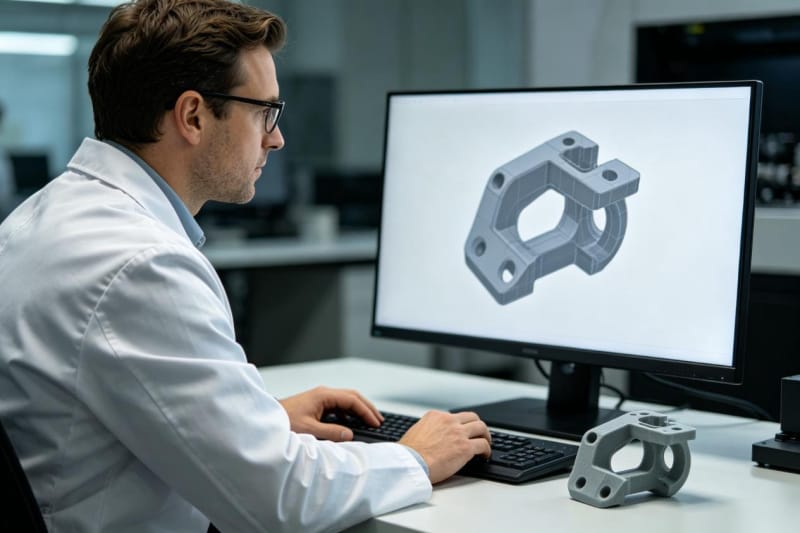
Rejected layers do not reach the buyer. HUANYA customers receive parts whose wall density, appearance and dimensions pass the same check on every run; if a sample shows thin roads or surface pops, that run is quarantined and reprinted, never "shipped as is". That is the difference between a fdm printing service and a print shop that hopes the weekend job came out fine.
What it means for buyers reordering parts
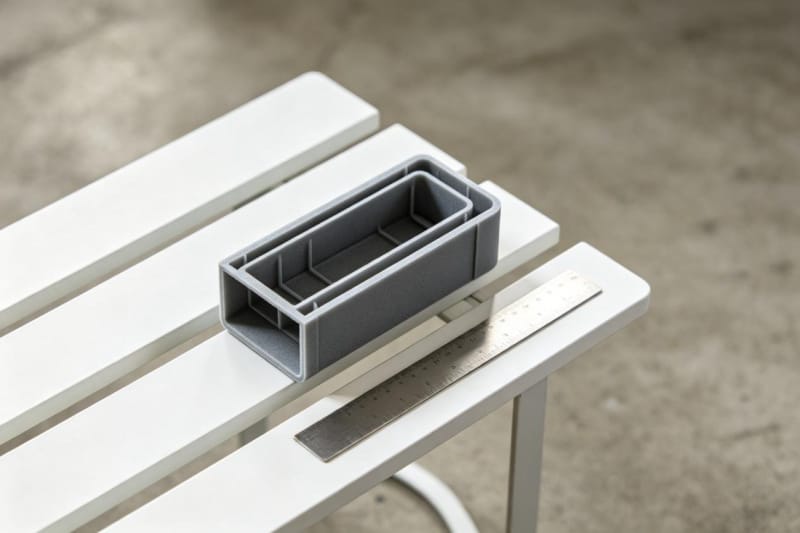
Under-extrusion has a nasty habit of appearing on the second batch, not the first. The sample came off a fresh nozzle and a dry spool; three months later, a reordered run on a tired machine and a humid warehouse quietly produces weaker, rougher copies. Buyers who only checked the first article never notice until a fitting fails in the field. HUANYA keeps the same parameters, the same drying step and the same inspection on every reorder, so month six matches month one.
Repeat orders are where sloppy services get exposed. A supplier that skips the pre-build drying check, reuses an unmaintained nozzle, or ships uninspected runs will keep delivery dates but silently downgrade the part — and the buyer finds out through a warranty claim, not a quote. HUANYA plans against real machine condition and logs every batch, so delivery delays and quality drift do not arrive after the promised date.
How HUANYA keeps under-extrusion out of your parts
Under-extrusion is predictable, measurable and preventable: dry the material, calibrate the path, lock the profile, watch the run, and inspect the result. Upload your CAD to HUANYA, state function and quantity, and receive parts whose walls are fully filled, whose dimensions hold, and whose repeat orders match the first sample — the way industrial FDM parts are supposed to behave.


Leave a Comment