
 English
 French
 Deutsch
 العربية
 Español
 Русский
 にほんご
にほんご Português
 한국어
한국어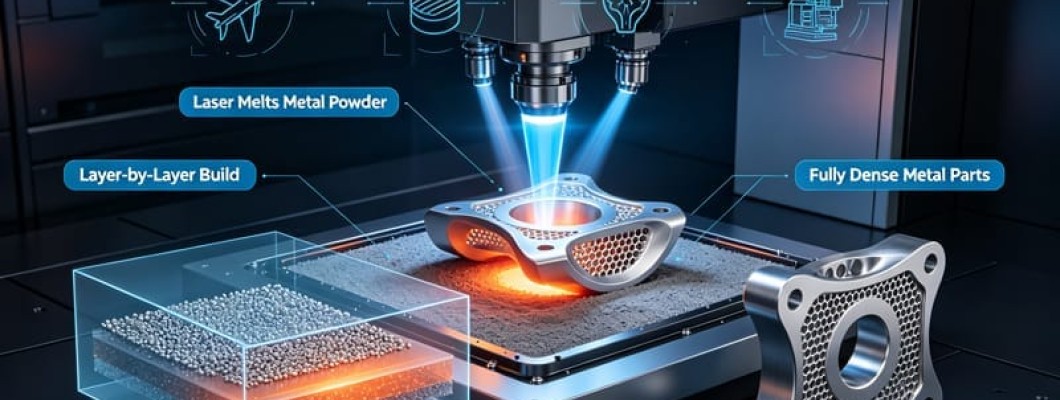
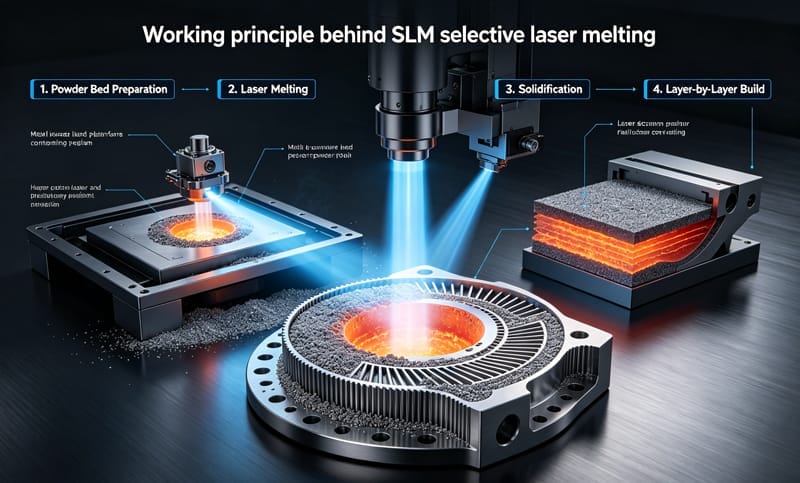
Working principle behind SLM selective laser melting
Selective Laser Melting (SLM) is a powder‑bed metal 3D printing technology that uses high‑power fiber laser to fully melt metallic powders layer‑by‑layer to build functional metal components. Unlike sintering‑based processes, SLM achieves near‑full density comparable to forged metal, so printed parts can be directly deployed for real‑world industrial operating conditions. HUANYA3D runs industrial multi‑laser SLM systems supporting stainless steel, titanium alloy, superalloy and tool steel. Our 3D printing workflow starts with professional DFM assessment to identify thermal‑stress risks and design proper support structures to prevent warpage and cracking. This manufacturing method fits perfectly for one‑off prototypes and low‑volume custom runs without expensive tooling investment. Complex closed cavities, weight‑saving lattices and intricate internal channels impossible for CNC machining can be manufactured in one single piece. As‑printed blanks require post‑processing workflows including stress‑relief heat treatment, support removal, precision machining and blasting to guarantee dimensional accuracy and reliable mechanical performance for final assembly.
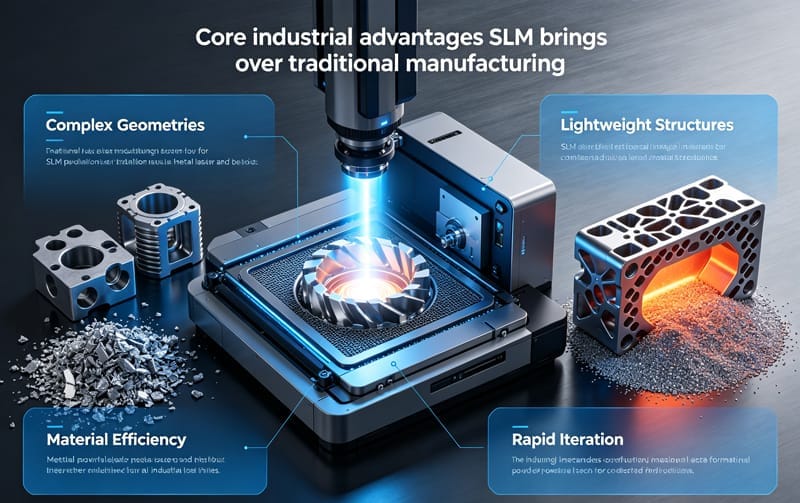
Core industrial advantages SLM brings over traditional manufacturing
Many mechanical engineers struggle to choose between CNC machining, casting and SLM 3D printing for metal components. Conventional manufacturing often forces designers to split one complex assembly into multiple separate pieces which are then welded together, creating potential weak points along welding seams. SLM enables part consolidation, merging dozens of assembled components into one monolithic piece and eliminates welding‑related failure risks. Topology‑optimized lattice structures cut component weight while maintaining required mechanical strength, delivering huge value for aerospace and new‑energy equipment development. HUANYA3D provides one‑stop SLM service covering DFM evaluation, printing, heat treatment, precision machining and inspection. Design revisions only need updated CAD files without re‑making costly molds, drastically accelerating product iteration cycles especially for low‑volume R&D batches. Nevertheless SLM is not universal: simple regular geometries remain more cost‑effective via CNC. The real competitive edge of SLM 3D printing lies in complex internal cavities, lattices and conformal cooling channels that traditional manufacturing cannot practically produce.
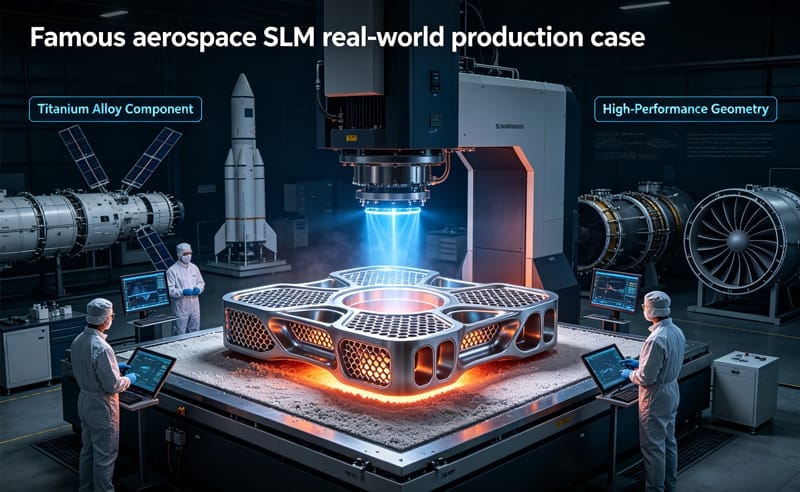
Famous aerospace SLM real‑world production case
The GE LEAP engine fuel nozzle stands as one of the most iconic industrial success stories of SLM metal 3D printing. Originally this critical component was assembled from more than twenty individual parts joined by brazing processes, resulting in complicated workflows, low yield rates and potential leakage risks caused by defective brazing joints. SLM additive manufacturing consolidated all these pieces into a single monolithic part, cutting component weight by 15 percent while improving service life and fuel efficiency for mass aircraft deployment. Drawing inspiration from this proven case, HUANYA3D supports similar low‑volume custom projects for research institutes and industrial equipment clients, producing lightweight aerospace brackets, fluid heat exchangers and engine test samples via SLM 3D printing. Before SLM existed, mechanical designers had to compromise performance ideas to fit machining limitations. Modern 3D printing removes manufacturing constraints: engineers prioritize functional performance first, then adapt geometry for DFM requirements. Low‑batch production allows innovative designs without huge upfront tooling risks.
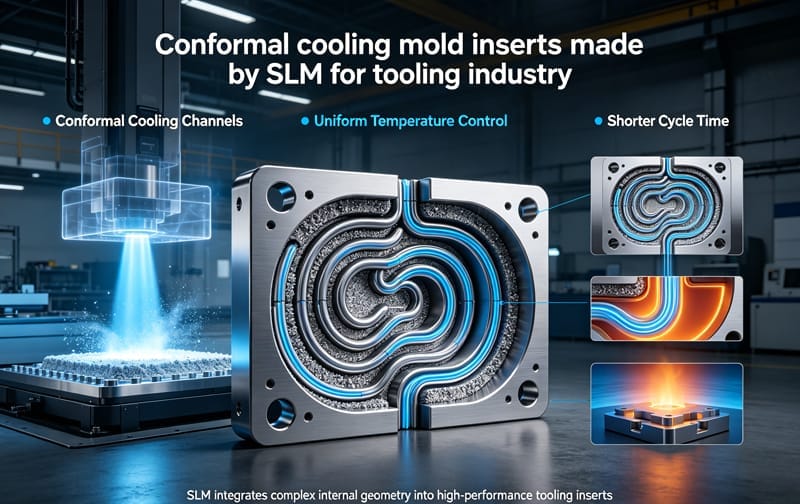
Conformal cooling mold inserts made by SLM for tooling industry
Mold manufacturing represents one of the fastest‑growing commercial application fields for SLM 3D printing. Traditional drilled cooling channels are limited to straight lines and cannot closely follow contoured mold cavity surfaces. Hot‑spots inside molds cannot dissipate heat rapidly, lengthening injection cycles and generating high rates of warpage, bubble defects on molded plastic products. SLM selective laser melting solves this bottleneck by building conformal cooling channels inside mold inserts. Curved cooling passages follow every contour of molding surfaces, accelerating heat dissipation and shortening injection molding cycles by 30‑50 percent while reducing part defects. HUANYA3D supplies low‑volume custom SLM mold inserts for injection and die‑casting industries, delivering finished inserts after complete printing and post‑processing. Many mold manufacturers order small‑batch SLM inserts to validate cooling performance during new‑product development. Once cooling performance is verified, mass‑production tooling decisions can follow. This approach greatly reduces trial‑and‑error costs and speeds up time‑to‑market for new consumer and industrial products.


Leave a Comment