
 English
 French
 Deutsch
 العربية
 Español
 Русский
 にほんご
にほんご Português
 한국어
한국어
28 Aug
Why Metal Prototyping Is Not a Simple Either-Or Choice
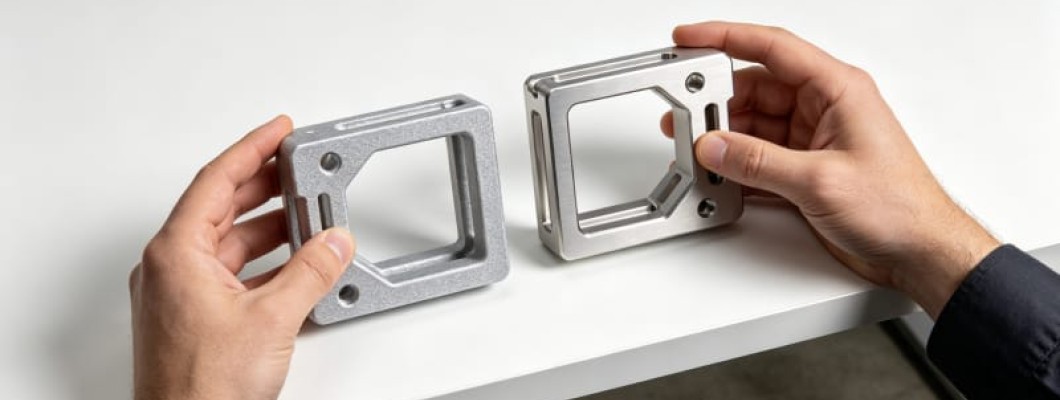
When engineers face a metal functional prototype requirement, the most common question is: 3D printing or CNC machining? The question itself implies a false assumption—that the two processes are mutually exclusive alternatives. In reality, metal additive manufacturing (SLM/DMLS) and CNC milling follow fundamentally different economic curves across design freedom, material utilization, lead time, and unit cost. Choosing the wrong process wastes budget and may produce a prototype that cannot validate the design intent. At HUANYA, we operate both metal 3D printing and precision CNC machining lines, recommending the optimal process combination based on geometry, functional requirements, and batch size rather than pushing every project through a single technology.
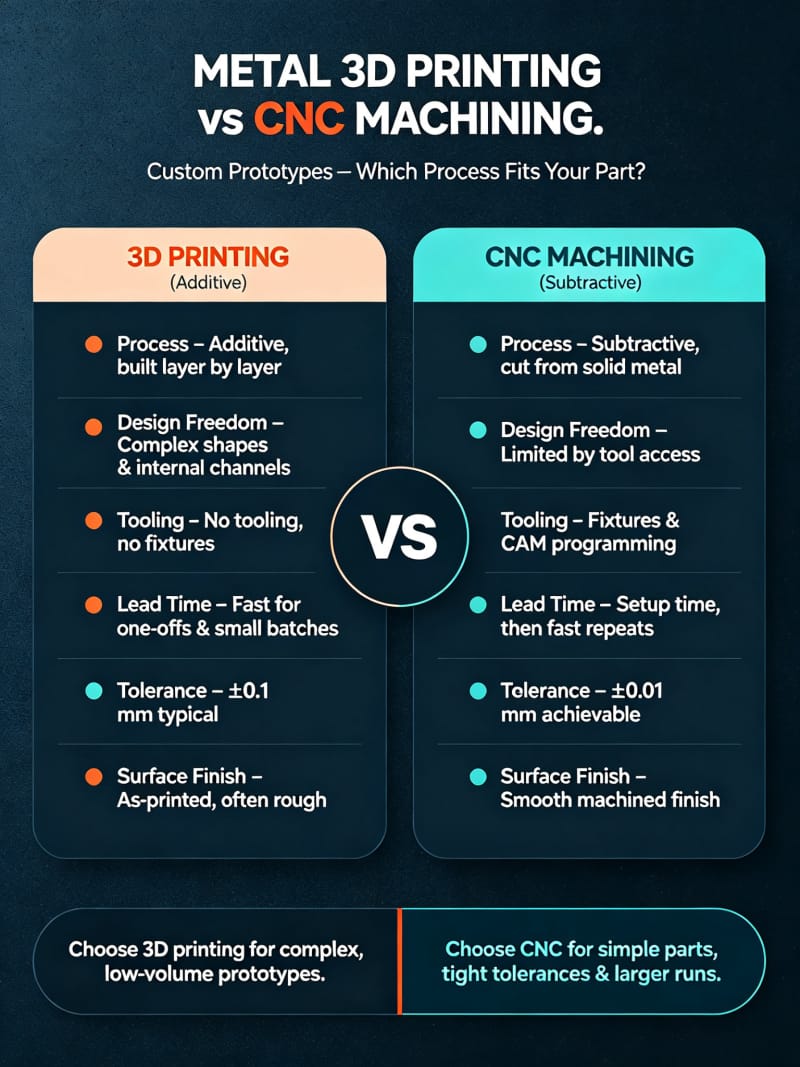
The first step to understanding the difference is acknowledging that their manufacturing logic is fundamentally different. CNC machining starts from a solid billet, removing material with cutting tools—a subtractive process that excels at high-precision simple geometries but cannot reach internal cavities, conformal cooling channels, or lightweight lattice structures without multi-component welding. Metal 3D printing starts from metal powder, melting it layer by layer with a laser—an additive process with almost unlimited geometric freedom but higher as-built surface roughness and lower ultimate precision than precision grinding. The following sections compare both processes across six dimensions to support data-driven decisions.
Geometric Complexity The Structural Advantage of Additive
Metal 3D printing's most irreplaceable advantage is geometric freedom. Conformal cooling channels can follow mold cavity contours for uniform heat dissipation, reducing injection molding cycle times by 20-40%; topology-optimized lightweight brackets achieve 30-60% weight reduction while maintaining stiffness; internal lattice structures provide customizable damping and energy absorption that CNC tooling simply cannot reach. In aerospace and medical implants, these complex structures have moved from laboratory to production. If your metal prototype needs to validate precisely this kind of innovative geometry, CNC cannot provide an equivalent prototype—even if feasible, it would require splitting the part into multiple welded assemblies, introducing alignment errors and additional cost.
But geometric complexity is not a decision factor in every scenario. For simple block parts, flanges, mounting plates, or regular shafts, CNC machining remains superior in precision, surface quality, and material consistency at lower cost. 3D printing these simple geometries wastes the technology's advantage. HUANYA's engineering team evaluates each 3D file for geometric complexity—overhang ratio, internal cavity accessibility, minimum feature size, and assembly requirements—before recommending a process. For hybrid parts with both complex zones and precision mating surfaces, we typically recommend 3D printing near-net shape followed by CNC finish machining of critical features.
Material Properties Density Strength and Anisotropy
Mechanical performance of metal 3D printed parts has long been engineers' top concern. Modern SLM uses high-power fiber lasers to melt metal powder layer by layer under inert gas; optimized parameters achieve density above 99.5%, with tensile and yield strength approaching or in some directions exceeding wrought standards. For 316L stainless steel, SLM parts typically reach 550-650 MPa tensile strength, 400-500 MPa yield strength, and 25-40% elongation, largely overlapping the ASTM A276 bar stock range. Note that printed parts exhibit some anisotropy—Z-axis (build direction) elongation and fatigue strength are typically 10-15% lower than the XY plane, so part orientation must be optimized for loading conditions.
CNC machining's material advantage is that it uses forged or rolled billets with complete thermomechanical history, isotropic properties, and mature standards-based traceability. For fatigue-critical, load-bearing, or certification-required aerospace and medical parts, CNC from certified bar stock can directly cite material standard data, while 3D printed parts require additional process validation and coupon testing. The table below compares typical mechanical properties of both processes across common metals to support initial material selection.
Material | Process | Tensile (MPa) | Yield (MPa) | Elongation (%) | Density |
|---|---|---|---|---|---|
316L SS | SLM printed | 550-650 | 400-500 | 25-40 | >99.5% |
316L SS | CNC wrought | 515-690 | 205-310 | 30-60 | 100% |
AlSi10Mg | SLM printed | 300-420 | 200-280 | 3-10 | >99.5% |
6061-T6 Al | CNC wrought | 310 | 276 | 12-17 | 100% |
Ti6Al4V | SLM printed | 900-1100 | 800-1000 | 6-14 | >99.5% |
Ti6Al4V | CNC wrought | 895-1000 | 825-900 | 10-15 | 100% |
Accuracy and Surface Finish The Real Gap
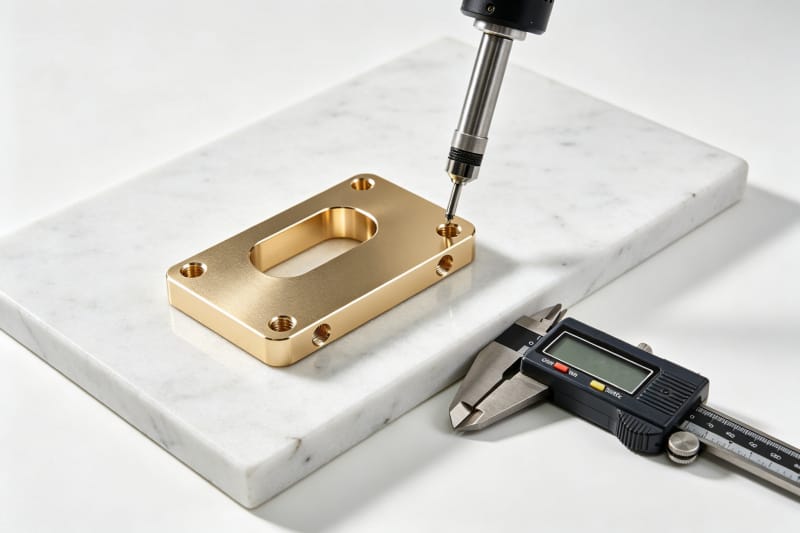
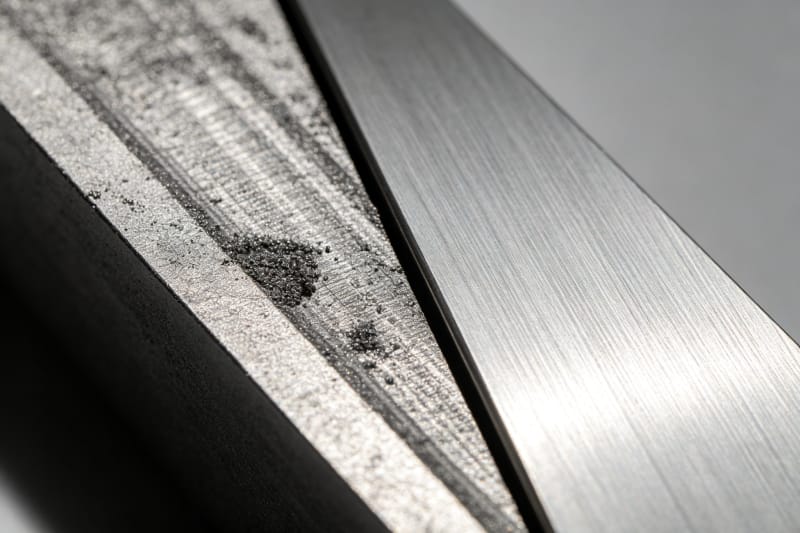
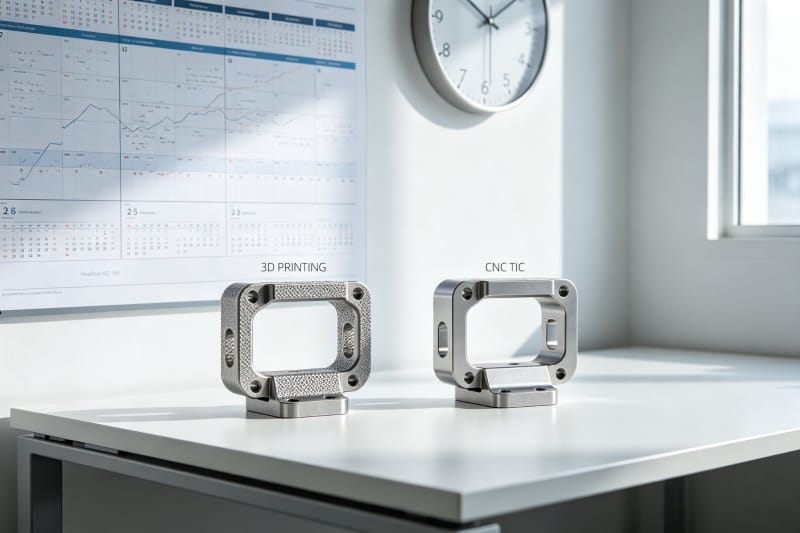
CNC machining remains the gold standard for metal part dimensional accuracy. Precision 3-axis centers consistently achieve ±0.01 to ±0.05 mm positioning accuracy; 5-axis simultaneous machining maintains similar precision on complex surfaces. Surface finish reaches Ra 0.8-1.6 μm after finish milling and below Ra 0.2 after grinding or polishing. Metal 3D printing as-built surface roughness is typically Ra 6-12 μm for SLM, with visible layer lines and powder adhesion; dimensional accuracy is generally ±0.05 to ±0.1 mm, requiring secondary CNC finishing for IT6 or tighter mating surfaces.
This does not mean 3D printed parts cannot serve precision functional validation. Through smart process design—leaving 0.3-0.5 mm machining allowance on critical mating surfaces, then CNC finish milling after printing—you simultaneously gain additive geometric freedom and CNC precision surfaces. HUANYA's hybrid manufacturing flow does exactly this: SLM prints near-net blanks, stress-relief heat treatment follows, then a 5-axis center finishes all mating surfaces, threads, and sealing faces in one setup. Critical dimensions reach ±0.02 mm and surface roughness Ra 0.8 μm, indistinguishable from pure CNC parts while retaining internal structures only 3D printing can create.
Lead Time and Cost Structure Compared
Lead time is the most practically significant dimension in metal prototyping decisions. CNC machining requires programming, fixturing, tool selection, and multi-operation routing, typically taking 5-10 business days for complex parts; custom fixtures or 5-axis programming can extend this beyond two weeks. Metal 3D printing eliminates toolpath programming and fixture preparation—once file processing completes, printing begins, with simple parts delivering in 3-5 business days and complex parts typically 7-10 days. However, 3D printing machine hourly rates exceed CNC, and for simple geometries material and machine costs may make 3D printing more expensive.
The cost crossover occurs at two variables: geometric complexity and batch size. For simple geometries, CNC is more economical at both single-piece and small-batch levels. For complex geometries, 3D printing cost does not scale linearly with complexity, while CNC cost rises sharply with machining difficulty. For batch size, 3D printing needs no tooling so unit cost barely changes from 1 to 10 pieces; CNC programming and fixturing costs amortize over volume, making CNC increasingly advantageous at higher quantities. The table below summarizes both processes across key decision dimensions.
Dimension | Metal 3D Printing (SLM) | CNC Precision Machining |
|---|---|---|
Typical lead time | 3-10 business days | 5-15 business days |
Dimensional accuracy | ±0.05-0.1 mm | ±0.01-0.05 mm |
Surface roughness Ra | 6-12 μm (as-built) | 0.8-1.6 μm (finish milled) |
Max part size | Build chamber limited (~280mm) | Machine travel limited (meters) |
Material utilization | 90-97% (powder recyclable) | 30-70% (chip waste) |
Internal channels | Natively supported | Cannot machine as one piece |
Tooling/programming | No tooling needed | Programming and fixtures |
Suitable batch | 1-50 pcs | 1-1000+ pcs |

Post-Processing and Hybrid Process Value
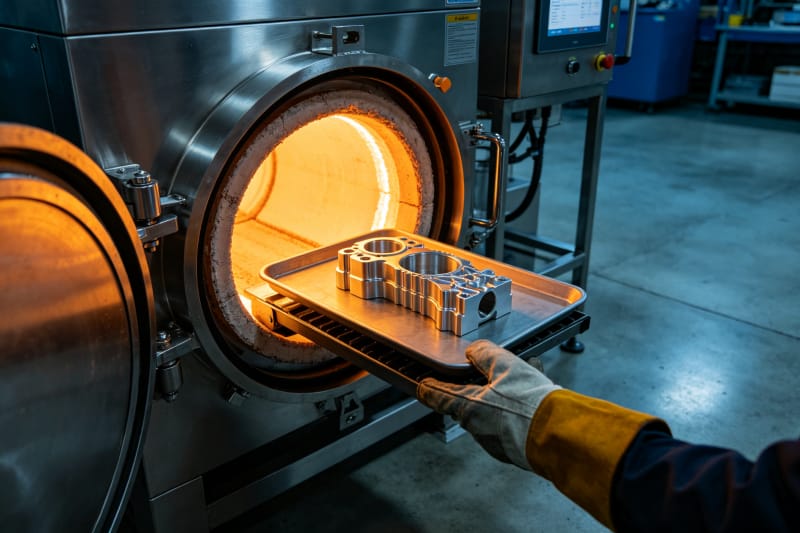
Metal 3D printed parts are rarely usable straight from the printer. Standard post-processing includes: powder removal, stress-relief annealing, support removal, heat treatment (solution/aging), bead blasting, CNC finish machining of mating surfaces, and surface treatment. Each step affects final performance and precision. Stress-relief prevents machining deformation; hot isostatic pressing (HIP) reduces internal porosity below 0.1%, significantly improving fatigue life; CNC finishing ensures mating surfaces meet tolerances. Skipping any step can cause poor test performance—precisely what print-only vendors tend to overlook.
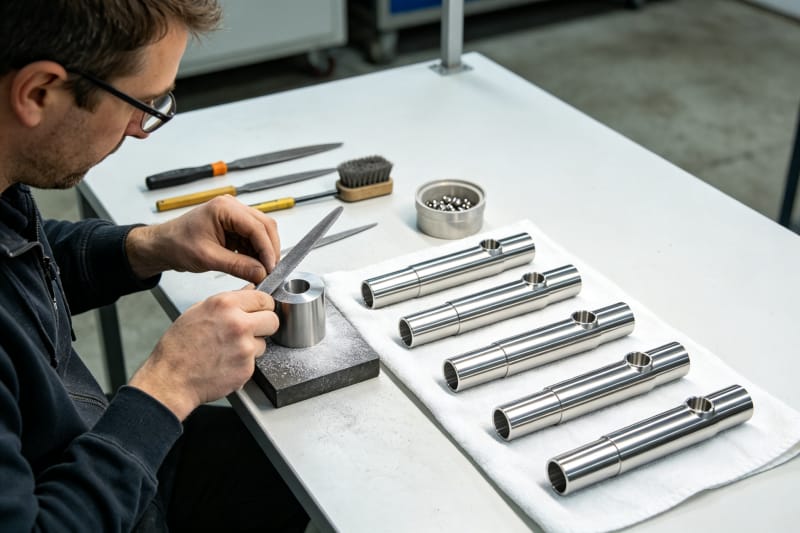
CNC machined parts require simpler post-processing: deburring, anodizing, or plating. But CNC cannot overcome design-stage geometric limitations. The real value of hybrid processes is playing to each technology's strengths—using 3D printing for internal structures and complex contours that CNC cannot achieve, and CNC for precision mating surfaces and tolerances. At HUANYA, we complete SLM printing, heat treatment, 5-axis CNC finishing, and surface treatment in one facility, avoiding multi-vendor coordination delays and finger-pointing. Every hybrid part ships with a complete process routing sheet and inspection report.
Selection Strategy for Low-Volume Scenarios
When projects move from prototype to low-volume production (10-500 pcs), the economic logic shifts. 3D printing needs no tooling investment in the 1-50 piece range with stable unit cost, ideal for bridge production validating market demand. Above 50 pieces, CNC programming and fixturing costs amortize, the broader alloy bar stock range becomes available, and unit cost gradually drops below 3D printing. If final production will be casting or forging, 3D printing bridge production avoids expensive hard tooling; if production remains machined parts, CNC is more logical for low volume.
A common scenario involves parts with both complex and simple zones—for example, a mold insert with conformal cooling channels whose outer shape and mounting faces need precision grinding. The optimal solution is hybrid: 3D print the conformal channel section, CNC machine the mounting faces and cooling interfaces. HUANYA supports this one-stop hybrid manufacturing: customers provide one 3D file, and we handle process splitting, printing, heat treatment, machining, and quality inspection end to end, delivering a ready-to-install finished part rather than a semi-finished product requiring multi-vendor coordination.
HUANYA Dual-Process Capability
The most critical criterion when choosing a metal prototyping supplier is not what equipment it owns, but whether it can recommend the correct process for your specific part. HUANYA operates industrial SLM metal printing systems and precision CNC machining centers, covering stainless steel, aluminum, titanium, and tool steel. We do not have problems with unstable dimensional accuracy, delivery delays, or inconsistent post-processing quality—these are exactly the risks we eliminate through standardized process routing, in-process inspection, and complete documentation. Upload your 3D file and our engineering team will return process recommendations, lead time, and a 3d printing quote within hours, whether you need pure additive, pure subtractive, or a hybrid solution.



Leave a Comment