
 English
 French
 Deutsch
 العربية
 Español
 Русский
 にほんご
 Português
 한국어
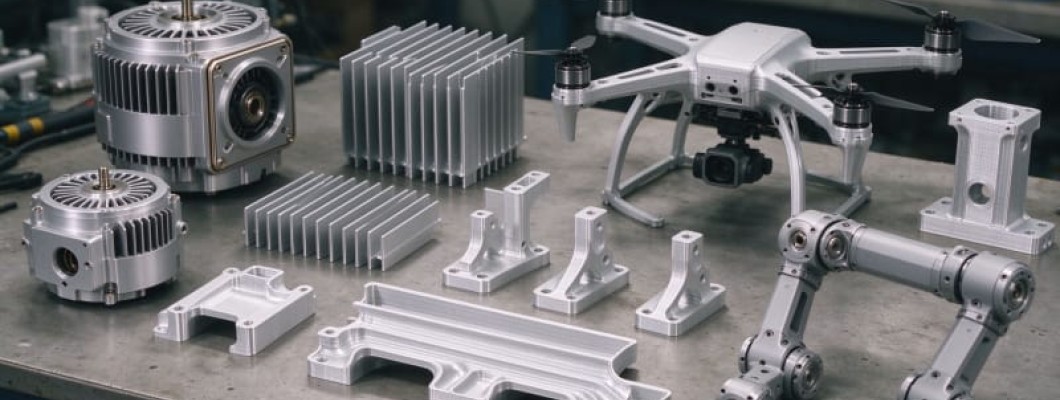
Aluminum parts printed for production
When a product team needs a bracket, a motor mount or a fluid component in tens rather than thousands, aluminum 3d printing turns a CAD file into a functional metal part without a die or a long tooling queue. The part is built layer by layer, emerges dense and dimensionally stable, and moves straight into the heat treatment and finishing steps an industrial buyer expects.
Inside an SLM machine a fiber laser scans a thin layer of atomized aluminum powder under a blanket of argon. The platform lowers one layer, a recoater spreads fresh powder, and the next pass fuses metallurgically to the layer below. Because each layer is fully melted rather than glued, AlSi10Mg parts reach relative densities above 99.5 percent, close to a wrought or cast reference.
How the laser fuses aluminum powder
The build plate holds a surprising number of parts at once. Dozens of aluminum components stand on supports in three dimensional space, not just on a flat sheet, and a technician separates them with wire EDM or hand tools once the run is complete. The unused powder is sieved, dried and blended back with virgin material at a documented ratio, so every build starts from controlled, traceable input.
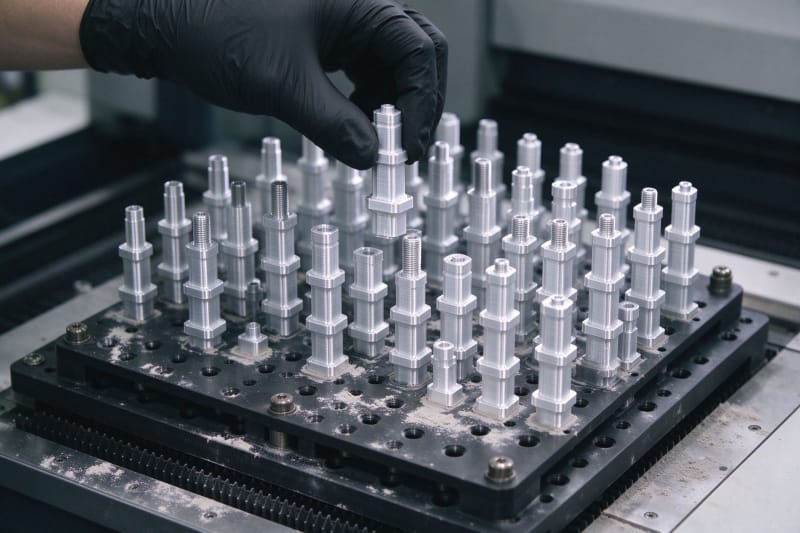
Dimensional accuracy follows the process and the orientation. A well calibrated SLM line repeats 30 to 60 micron layers, and critical bores or mating faces are machined after heat treatment when the drawing calls for it. The table below compares the common aluminum routes by alloy, tolerance and tooling, so a buyer can choose SLM, DMLS, die casting or CNC before releasing a request for quote.
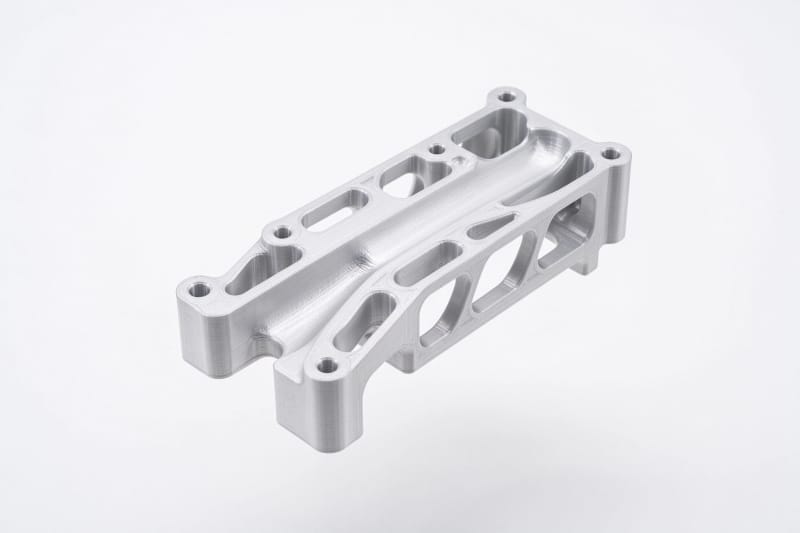
Selecting an aluminum alloy and process
The alloy library decides what a part can do. AlSi10Mg combines good strength with thermal performance and is the natural choice for housings, heat sinks and lightweight structures, while AlSi7Mg offers a little more ductility and a well documented T6 response. Each powder is sieved to a narrow particle range, dried and tracked by lot before it reaches the machine.
The comparison below lists the process, the representative aluminum alloys, the typical tolerance and whether hard tooling is required. It helps a purchasing engineer match the geometry to the route instead of forcing a complex printed part onto a high volume die cast quote.
Process | Aluminum alloy | Typical tolerance | Tooling | Typical application |
SLM / LPBF | AlSi10Mg / AlSi7Mg | ±0.05–0.2 mm | No mold | Complex lightweight functional parts |
DMLS | AlSi10Mg / AlSi7Mg | ±0.05–0.1 mm | No mold | Thin-wall high-strength parts |
High-pressure die casting | A380 / AlSi9Cu3 | ±0.1–0.3 mm | Steel mold required | High-volume housings |
CNC machining | 6061-T6 / 7075-T6 | ±0.02–0.05 mm | Fixtures required | Tight-tolerance structural parts |
Source: SLM Solutions and EOS process guides, Renishaw AlSi7Mg parameter data, ASTM B85 die casting tolerances (2026)
Complex geometries that remove weight
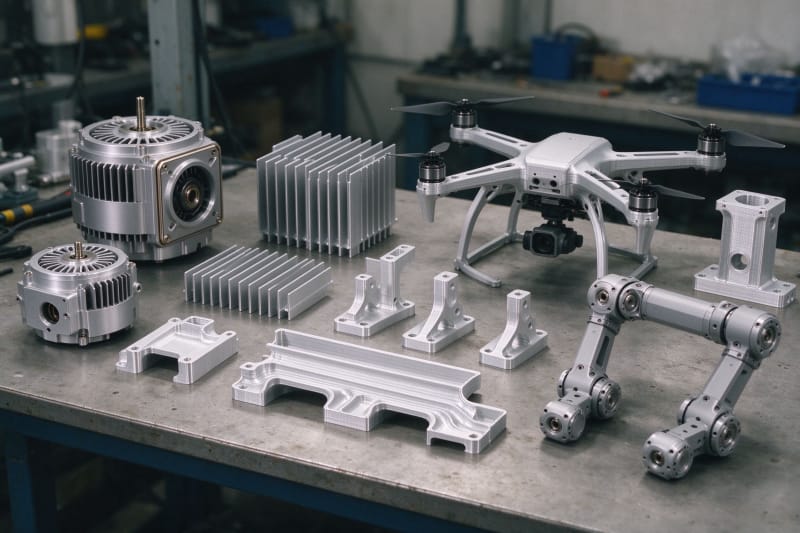
Printing unlocks conformal cooling channels, lattice cores, topology optimized brackets and consolidated manifolds that casting or machining cannot produce without assembly. A single printed bracket can merge several bolted components into one light web, cutting welds, leak paths and assembly labor. That geometric freedom is the reason automotive, robotics and drone teams move fluid and structural parts from conventional production.
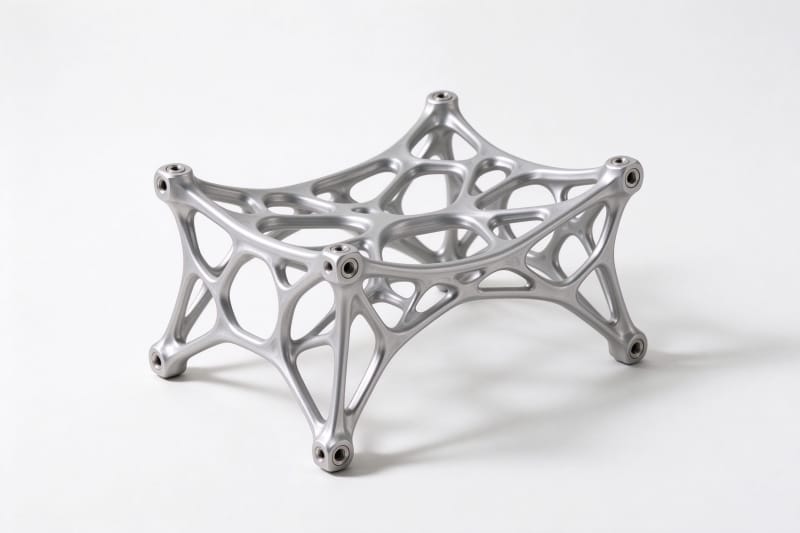
Real mechanical numbers separate a production aluminum part from a showpiece. The table below lists yield strength, ultimate tensile strength and density from published datasheets. As built AlSi10Mg yields 240 to 280 MPa, T6 treated AlSi10Mg reaches about 460 MPa tensile, and T6 AlSi7Mg reaches 421 to 425 MPa, so an engineer can size the part on measured data rather than guesses.
|
Source: EOS AlSi10Mg PDS, Renishaw AlSi7Mg datasheet, 3D Systems LaserForm AlSi10Mg, A380 and 6061-T6 published data (2026)
Quality checks at every station
Quality is confirmed at several stations rather than once at the end. Calibrated calipers and CMM arms measure critical dimensions, microscopes inspect layer fusion and surface density, and visual inspection catches support marks. For safety relevant parts, density coupons and the heat treatment curve are recorded before shipment, and as built AlSi10Mg conducts heat at roughly 100 to 130 W per meter kelvin for thermal applications.
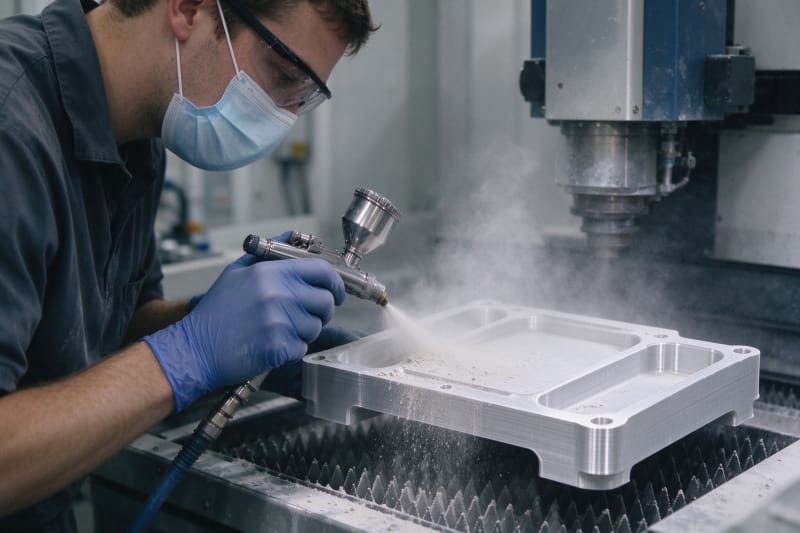
Heat treatment and finishing complete the part. Stress relief or a full T6 cycle stabilizes the microstructure, sand blasting creates a uniform matte surface, and HIP can close internal porosity when required. The best production design prints near net shape and then machines only the critical holes and faces, combining printed geometry with conventional precision.
Lead times costs and global delivery
For short runs the economics are predictable. There is no die and no long setup, nesting fills the chamber efficiently, and the same line supports rapid prototyping and industrial 3d printing under one roof. The metal 3d printing cost per part is higher for a handful of units but falls quickly as the nest fills, and a few hundred parts can compete with a cast geometry while shipping weeks earlier.
Starting a project with HUANYA is straightforward. Send a STEP or STL file, the engineering team reviews printability, recommends the alloy and process, orients the part for strength and tolerance, and returns a transparent quote with heat treatment, the density report and a firm delivery date. Whether it is a bracket, a manifold or a small production batch, the same line scales from a first prototype to repeat on demand orders.


Leave a Comment