
 English
 French
 Deutsch
 العربية
 Español
 Русский
 にほんご
 Português
 한국어
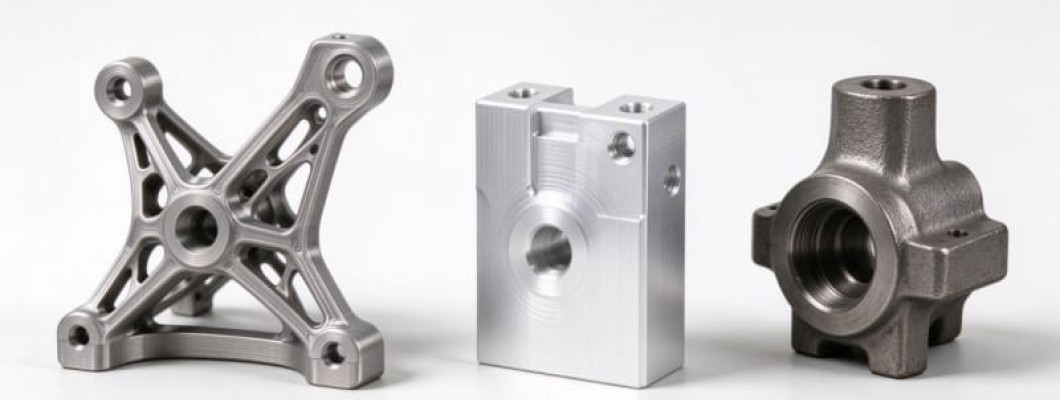
If you have ever asked a supplier for a quote and received a number that swung by 60 percent between vendors, you already know that metal 3D printing cost is not a single figure. It is a stack of decisions: material choice, build orientation, support strategy, post-processing route and batch size. At HUANYA, we quote thousands of metal parts every month, and the buyers who control their budget best are the ones who understand which lever moves the price.
The first lever is the powder. Laser powder bed fusion melts a thin layer of atomized metal powder, and that powder is priced like an engineered alloy. Roughly, 316L stainless steel powder runs about $60–90 per kilogram, AlSi10Mg aluminum powder sits near $90–140 per kilogram, and Ti6Al4V titanium powder climbs to $300–450 per kilogram. That gap is why stainless steel 3d printing and aluminum 3d printing serve very different budgets.
The second lever is machine time. A typical industrial LPBF system builds at roughly 5–20 cm³ per hour depending on layer thickness (30–60 μm) and laser strategy. Tall parts, fine features and dense fills push the build overnight; flat, thin-walled parts nest efficiently. The machine hour rate covers amortization of a 800,000 system, inert gas, recoater wear and facility overhead, so a 24-hour build is a real cost, not a marketing line.
Design complexity changes the bill more than most buyers expect. Overhangs steeper than roughly 45 degrees need support structures, which consume extra powder and hours to remove. Topology-optimized brackets, internal channels and lattices look radical on screen but often cost less in raw material than a solid block, because the machine only melts what the geometry needs. Orientation trades support volume against surface quality and accuracy.
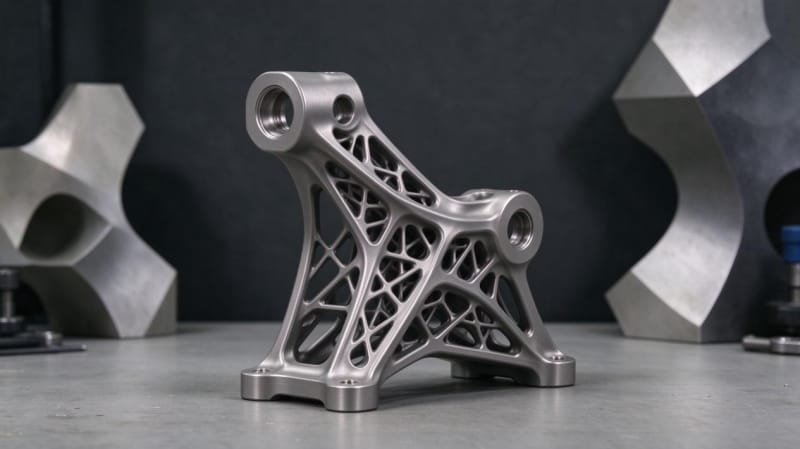
Topology-optimized titanium bracket
Post-processing is where many quotes hide. Stress-relief heat treatment, wire EDM off the plate, CNC milling of datums and threads, hot isostatic pressing, bead blasting and inspection can add 30–50 percent on top of the build itself. When buyers compare a metal 3d printing price to a CNC quote, they are often comparing a finished machined part against a raw as-printed part, and that mismatch explains most sticker shock.
To put this in context, the table below summarizes how the three common routes compare for a mid-size functional bracket in aluminum or stainless steel:
Route | Unit cost (low volume) | Lead time | Design freedom | Tooling |
Metal 3D printing (LPBF) | $150–600 per part | 7–15 days | Very high | None |
CNC machining | $80–300 per part | 10–20 days | Limited | None |
Investment casting | $30–90 per part (≥500 pcs) | 4–8 weeks | Moderate | Pattern tooling |
This is the heart of the 3d printing vs cnc machining question: for one-to-fifty complex parts, additive wins on flexibility; for five thousand simple prismatic parts, subtractive or casting still wins on unit price.
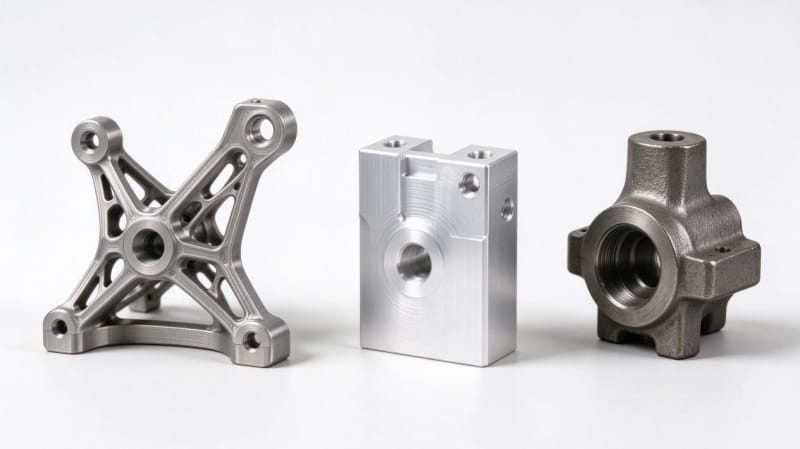
3D printed, CNC machined and cast parts comparison
The powder itself also varies in price, and that variation is worth planning around. The following reference bands are typical for industrial-grade gas-atomized powder used in LPBF:
Alloy | Approx. powder price (USD/kg) | Typical applications |
316L stainless steel | 60–90 | Fluid handling, food equipment |
17-4 PH stainless steel | 80–120 | Structural parts, fixtures |
AlSi10Mg aluminum | 90–140 | Automotive housings, heat exchangers |
Ti6Al4V titanium | 300–450 | Aerospace, medical implants |
Inconel 718 | 250–380 | Turbine, high-temperature |
Choosing a lower-tier alloy that still meets the load case often saves more than any negotiation on machine rate.
Batch nesting is the most underused lever. When a build plate is filled with forty identical brackets instead of three, the fixed machine-hour cost spreads across more parts and the per-part metal 3d printing price drops sharply. HUANYA's quoting engine nests your CAD automatically and shows you the price at 1, 10, 50 and 200 units on the same screen, so you can see exactly where the economy kicks in.
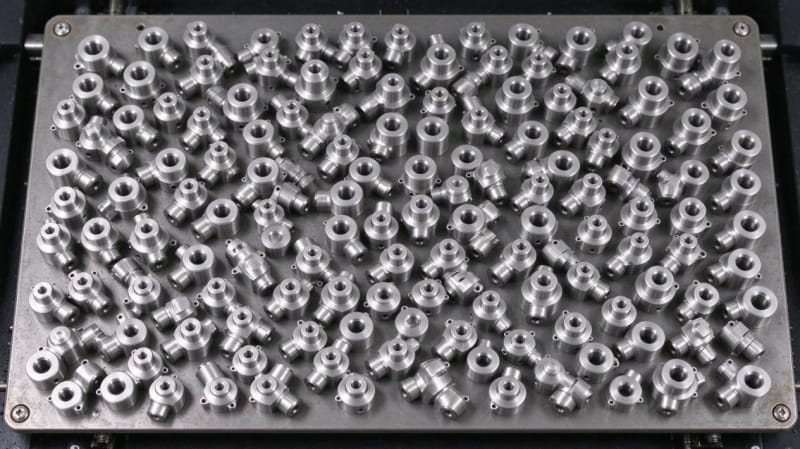
Densely nested batch build plate
You also control the bill at the CAD stage. Hollow sections with controlled wall thickness (1.5–3 mm for most alloys), integrated fastener bosses that eliminate assembly, and avoiding fine internal cavities that trap powder all reduce cost. A HUANYA DfM engineer reviews every file before it goes to print and flags features that will not build cleanly, so you are not paying for geometry that fights the process.
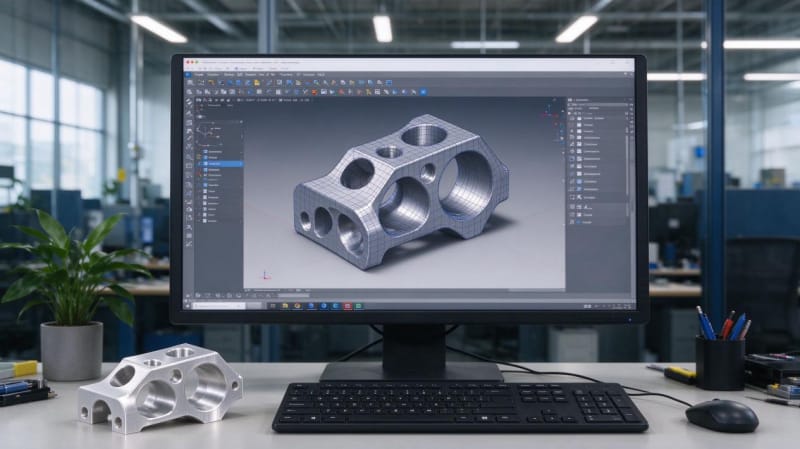
CAD workstation with physical printed part
There are costs nobody enjoys listing: nitrogen or argon consumption, powder recycling losses (typically 15–30 percent per build for reactive alloys), NDT and dimensional reporting. HUANYA rolls these into a single line rather than surprising you at invoice stage. Our published cost model assumes finished, inspected parts delivered to your dock, with no hidden surcharges for rush changes inside the agreed window.
Geography still matters. A vertically integrated factory that owns printers, EDM, CNC and heat treatment in one facility can quote a tighter total than a broker that subcontracts every step. HUANYA runs a controlled production floor in Dongguan with dedicated chambers for stainless, aluminum and titanium, which keeps material traceability clean and eliminates cross-vendor handoffs.
Ready to see what your part really costs? Upload your STEP or STL to HUANYA today, choose alloy and finish, and receive a price range within hours with a firm quote after DfM review. There is no setup fee for prototypes and no minimum order, so a single aerospace bracket and a fifty-part production batch follow the same transparent process.
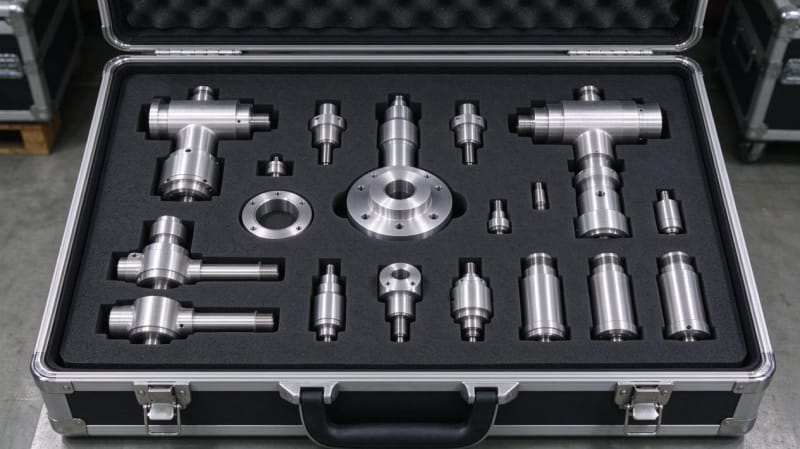
Finished metal parts in export case


Leave a Comment