
 English
 French
 Deutsch
 العربية
 Español
 Русский
 にほんご
 Português
 한국어
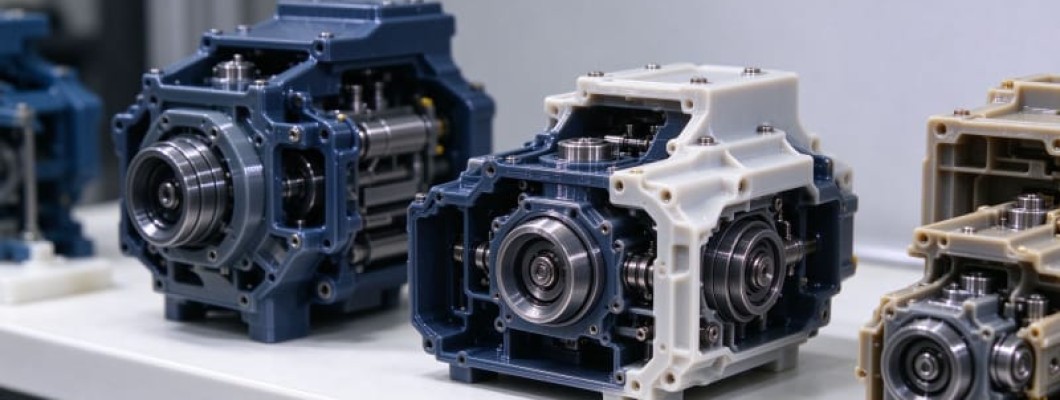
Every week a buyer asks us which technology is better, and the honest answer is that neither one wins across the board. SLA and SLS solve different problems: one produces smooth, precise surfaces, the other produces tough, functional parts without supports. The right choice depends on what the part must do, how it will be tested and what your budget window looks like. HUANYA runs both processes side by side, so our engineers can compare real samples instead of spec sheets.
SLA, or stereolithography, works like a high-precision photocuring machine. A UV laser traces each cross-section of the part inside a vat of liquid photopolymer resin, and the material hardens exactly where the beam passes. Layer by layer, a smooth part rises from the resin tank. Because the laser spot is fine and the layers are thin, SLA delivers crisp edges and fine details that are difficult to achieve with powder-based systems.
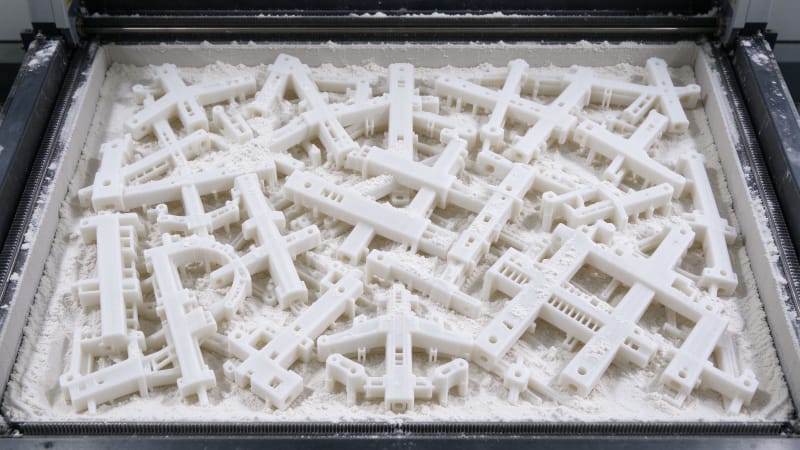
SLS, or selective laser sintering, takes the opposite approach. Instead of liquid resin, it uses fine nylon powder spread across a build chamber, and a laser melts the particles together at selected points. The un-melted powder stays in place during the build and acts as a natural support, so parts can be stacked and nested freely inside the bed. That single difference reshapes the whole cost and design logic.
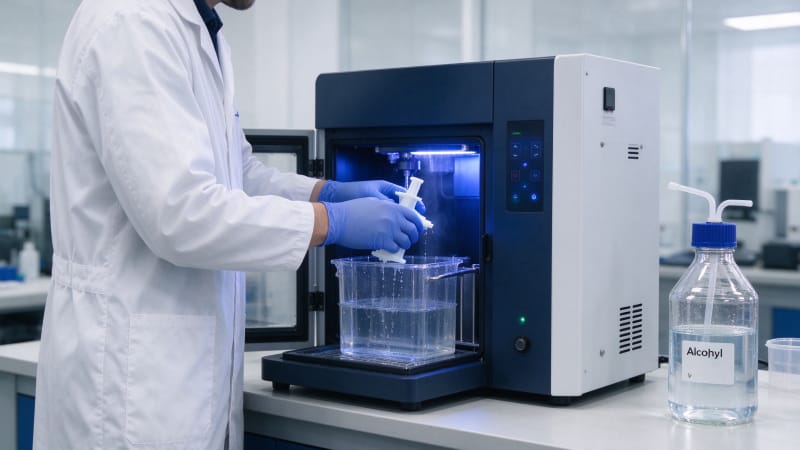
SLA and SLS accuracy comparison
Accuracy is usually the first question, and the numbers explain why SLA is preferred for visual fit testing. A typical SLA service runs layers of 25 to 100 micrometers with dimensional tolerances around plus or minus 0.1 to 0.2 millimeters. SLS builds thicker layers, usually 80 to 120 micrometers, and holds tolerances near plus or minus 0.3 millimeters. Both are repeatable, but SLA wins when a part must mate with another component tightly.
|
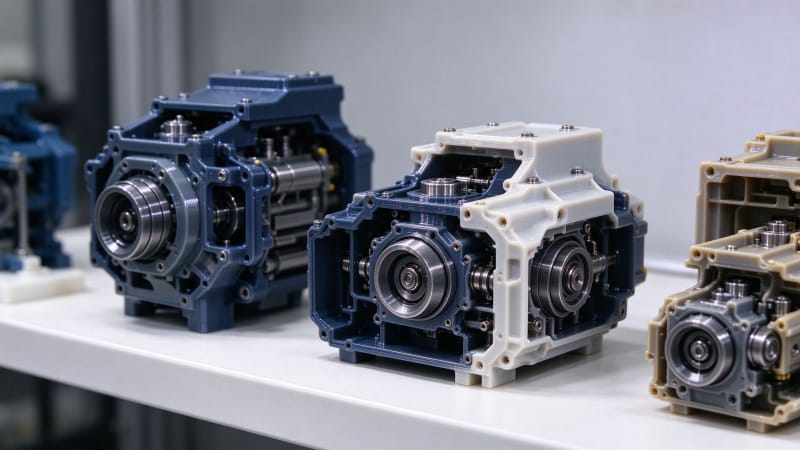
Fine detailed SLA resin parts with glossy surface
Surface quality follows the same pattern. A cured resin part comes out with a glossy, almost injection-mold-like finish, which makes SLA the natural choice for master patterns, silicone molds and client-facing presentation models. A sintered nylon part has a fine matte, slightly grainy texture that looks and feels functional. For products that will be painted or shown to end customers, SLA saves hours of sanding.
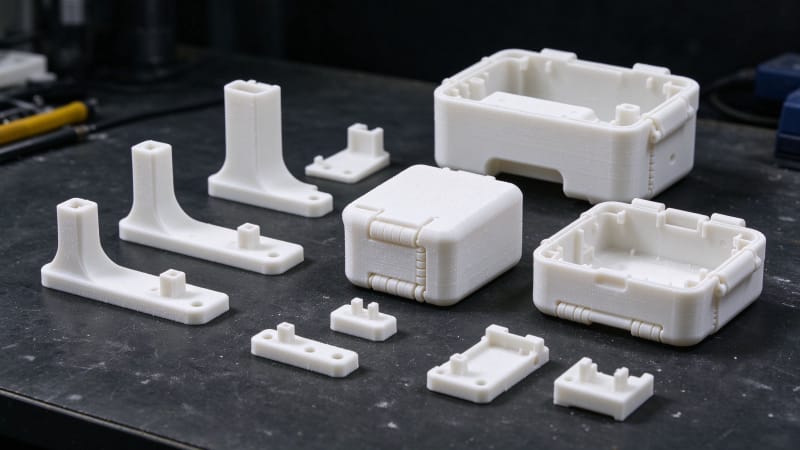
Matte white nylon SLS parts on workbench
Materials decide the mechanical story. Standard photopolymers deliver tensile strengths in the range of roughly 30 to 60 MPa, while engineering resins can go higher, but they remain brittle under impact. Nylon PA12 from an SLS service typically reaches 45 to 50 MPa and, more importantly, absorbs impacts and flexes without cracking. If the prototype will be dropped, clamped or hinged, SLS is usually the safer bet.
Material | Tensile strength | Impact behavior | Heat deflection |
SLA standard resin | ~30–60 MPa | Brittle, low elongation | ~55–65 °C |
SLS nylon PA12 | ~45–50 MPa | Ductile, high elongation | ~100–130 °C (grade dependent) |
Support structures are the hidden variable in every resin 3d printing quote. SLA parts need printed supports for overhangs, and someone must remove them, sand the touch points and post-cure the part. SLS needs no supports at all because the powder bed holds every feature in place. That freedom lets designers make channels, undercuts and lattice interiors without paying for removal labor, which is a major reason small batch production drifts toward SLS.
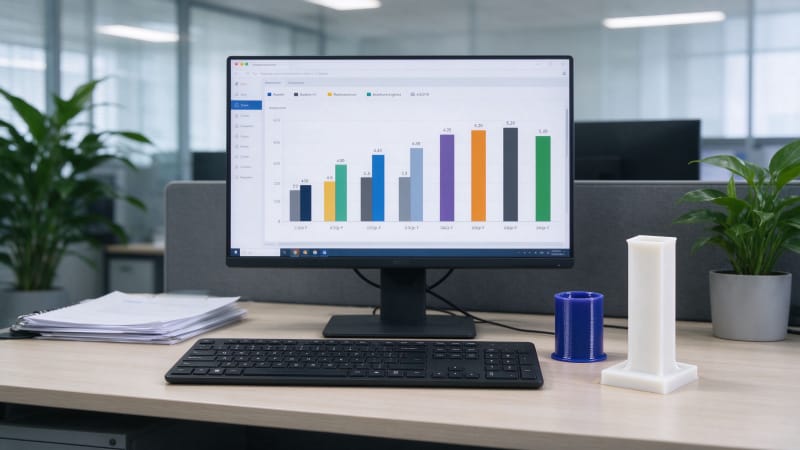
Cost comparison chart on engineering desk
Cost per part changes with quantity, and the crossover point is worth studying. For a single visual prototype, SLA often comes in lower because machine time and resin volume are both small. As quantities grow past a handful, SLS spreads its build volume across many nested parts and the per-piece price falls quickly. The table below shows typical reference ranges HUANYA sees for a mid-size housing of about 100 by 60 by 40 millimeters.
Quantity | SLA per part (USD) | SLS per part (USD) |
1–5 pcs | 20–80 | 50–150 |
10–50 pcs | 12–40 | 18–60 |
100+ pcs | 8–25 | 10–30 |
SLA washing and UV post-cure station
Post-processing also differs in rhythm. Resin parts are washed in solvent, support-trimmed and cured under UV light before shipment, which suits a 24 to 72 hour prototype flow. SLS parts are blasted to remove residual powder and can go straight to dyeing, vapor smoothing or assembly. For buyers comparing SLA vs SLS, the finishing step often decides which process fits their internal timeline better than the machine spec does.
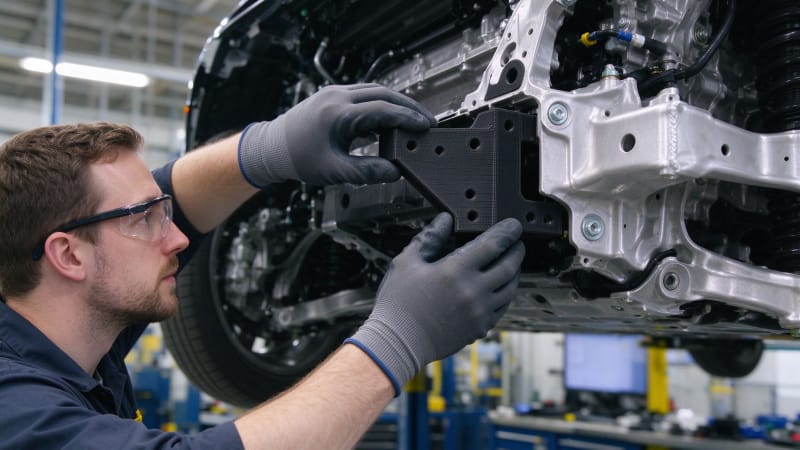
Functional nylon bracket fitted into automotive assembly
Applications map onto these strengths cleanly. SLA dominates high-detail visual prototypes, hearing aid shells, jewelry patterns and casting masters. SLS dominates functional brackets, snap-fit housings, living hinges, ducting and small batch production up to a few hundred pieces. When the same design is needed in both forms, HUANYA can print an SLA master for approval and then switch to SLS for the tested parts.
Choosing between SLA vs SLS also depends on how you plan production. If you are doing one-off validation before tooling, SLA gives the fastest route to a perfect-looking sample. If you need 30 to 300 working parts and want to avoid support labor, SLS is the more economical path. Many HUANYA customers run a two-stage strategy: SLA for form review, SLS for function testing.
HUANYA operates dedicated SLA and SLS lines in one controlled factory, with calibrated machines and documented material batches. Every order gets a DfM review that flags support issues, wall thickness and orientation before printing, so you are not surprised by a failed build or a hidden finishing charge. Our quoting engine shows both process options on the same screen whenever a file can be produced either way.
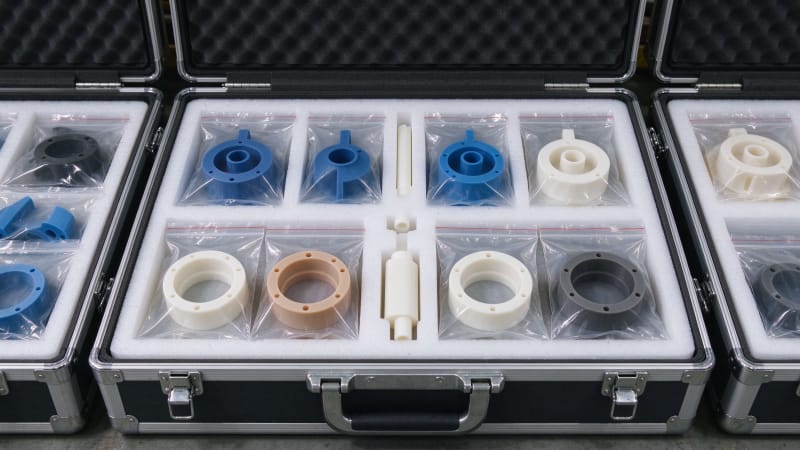
Finished SLA and SLS parts packed for delivery
Upload your STEP or STL to HUANYA and ask for a dual quote, one for SLA and one for SLS on the same part. You will see accuracy, lead time and price side by side, and our engineers will add a recommendation based on what the part has to survive. That comparison, based on your actual geometry, beats any generic article about which technology is better.


Leave a Comment